Lapidary practice Mineral properties
Cutting and polishing Larimar
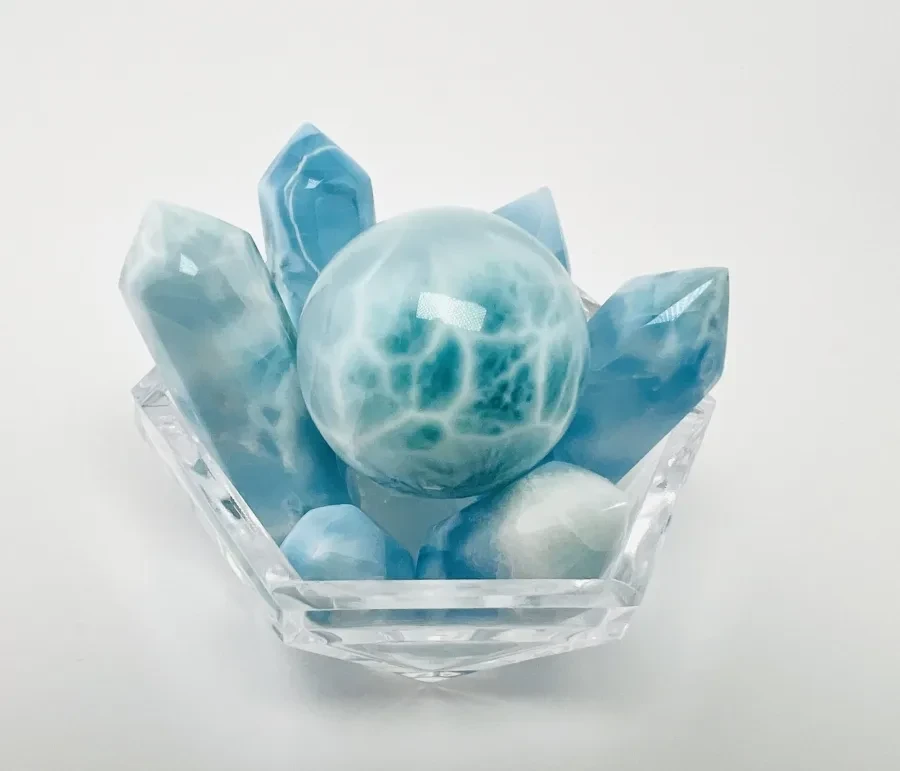
Larimar is commonly workable with diamond lapidary tools, but its fibrous aggregate structure, fractures, cavities and associated minerals demand attention. Pectolite is relatively soft on the Mohs scale, yet compact material can be tough. Soft does not mean obedient.
This guide explains principles rather than prescribing one universal machine, speed or abrasive recipe. Equipment, piece size, mineral association and operator experience change the details.
Safety first
Use appropriate:
- Eye protection
- Water-cooled cutting and grinding
- Splash control
- Electrical protection suitable for wet equipment
- Respiratory protection for any unavoidable dry dust
- Machine guards
- Secure work holding
- Hearing protection where required
Avoid dry grinding silicate material. Maintain equipment and follow the manufacturer’s instructions.
Reading the rough
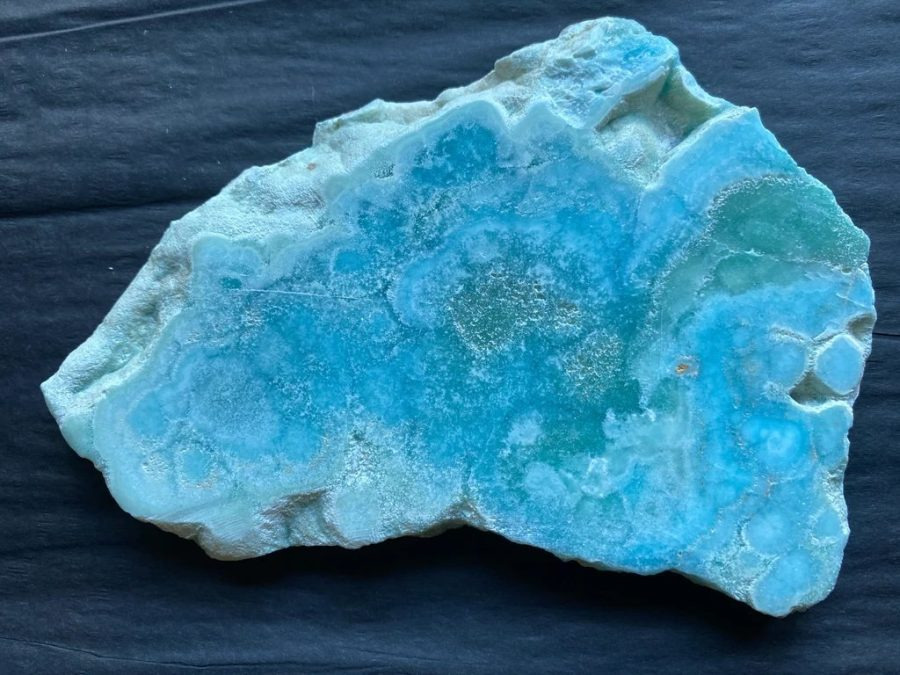
Study dry and damp surfaces, fractures, matrix and likely fibre direction. Decide whether the piece should remain a specimen before cutting it.
Strong pattern on one surface may disappear, change scale or rotate across the stone. Planning with multiple views reduces surprises, although geology retains the right to one or two.
Sawing
Use a sound diamond blade, adequate coolant and gentle support. Excessive force can wander the cut, chip the edge or open an existing fracture.
For fragile pieces:
- Support the stone fully
- Avoid gripping across a weak fracture
- Make relief cuts where appropriate
- Stop if vibration or unusual sound changes
- Reassess after every major cut
Preforming
Shape gradually. Avoid creating thin projections or sharp internal corners unless the material is strong enough and the design requires them.
Keep checking the back. Removing too much structural material to improve the face may produce a beautiful object with the lifespan of a soap bubble.
Sanding sequence
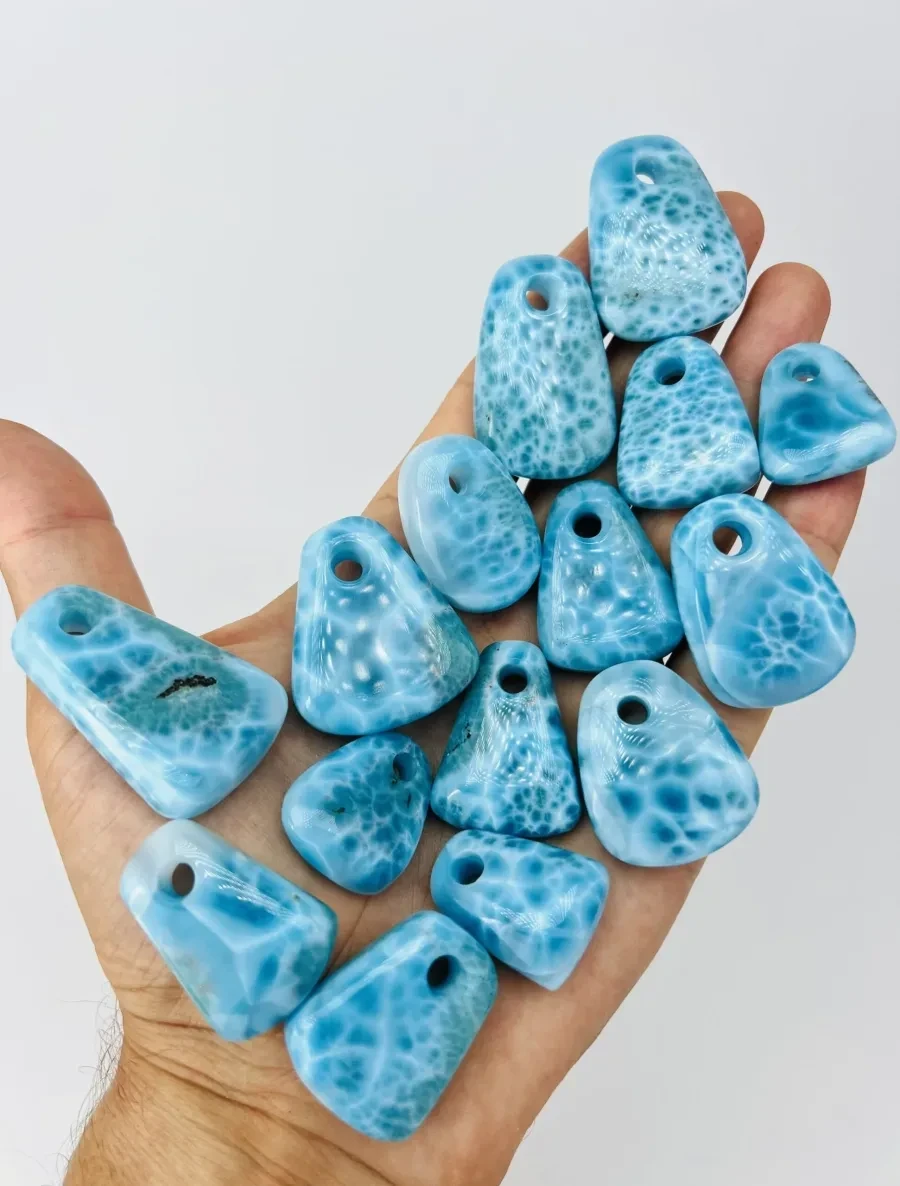
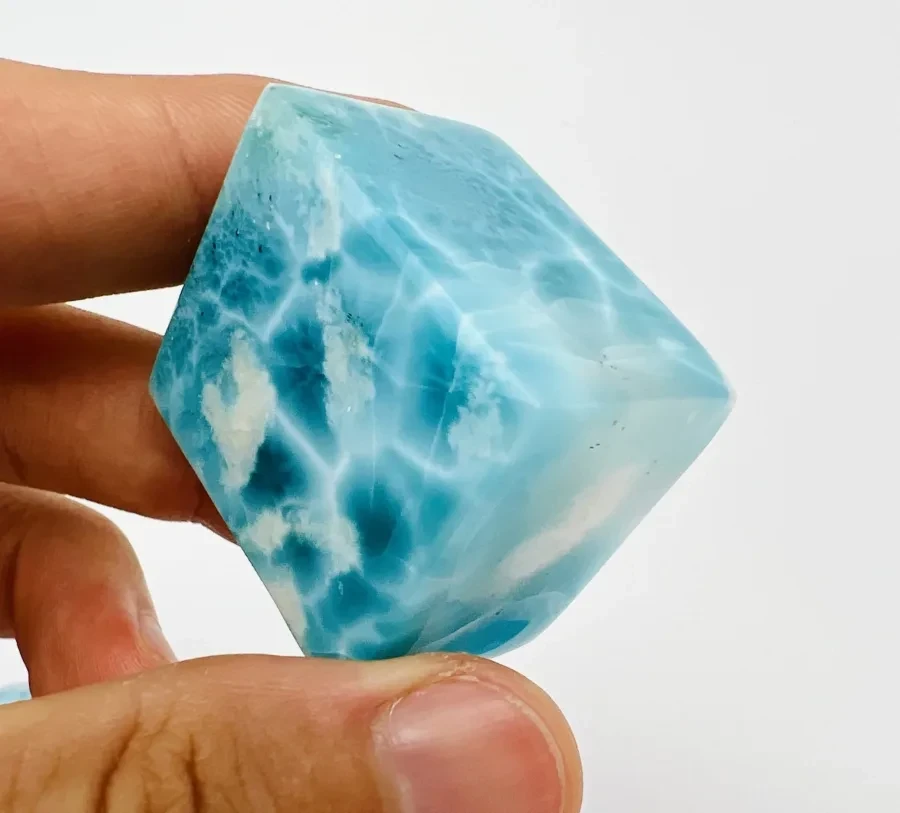
The exact abrasive series varies, but the principle is constant: each stage must remove the scratches and damage from the previous stage.
Clean the stone and work area between grit changes. A single coarse particle can reintroduce scratches late in the process.
Managing undercutting
Larimar may contain minerals with different hardness and polishing behavior. Softer zones can recess while harder areas remain proud. Control pressure, use appropriate backing and inspect frequently.
Some pits and cavities are natural features worth preserving; others compromise the intended finish. Decide deliberately and disclose the result.
Polishing
Test the polishing system on comparable material before using it on an exceptional piece. Keep heat low, avoid excessive pressure and inspect for:
- Orange peel texture
- Drag marks
- Residual sanding scratches
- Edge rounding
- Compound trapped in pores
- Color change caused by residue or surface coating
Do not use undisclosed resin, oil or wax to simulate a permanent polish or conceal fractures.
Repairs and stabilization
If adhesive, filler or stabilizer is used, record:
- Product
- Location
- Purpose
- Date
- Whether the treatment is visible
- Any care limitations
Treatment is not automatically misconduct. Undisclosed treatment is the problem.
Quality-control checklist
- Correct dimensions
- Stable structure
- Even intended shape
- Complete scratch removal
- Clean polish
- Safe edges
- Clean drill hole or setting surface
- No hidden residue
- Accurate treatment disclosure
- Final dry photographs
Sources and further reading
- Anthony, John W.; Bideaux, Richard A.; Bladh, Kenneth W.; Nichols, Monte C., eds. “Pectolite.” *Handbook of Mineralogy*, Mineral Data Publishing / Mineralogical Society of America, version 1.2. — link
- Woodruff, Robert E.; Fritsch, Emmanuel. “Blue Pectolite from the Dominican Republic.” *Gems & Gemology*, Winter 1989, vol. 25, no. 4, pp. 216–225. — link
- Huang, Hao-Ming; Shih, Yu-Hong; Chen, Huei-Fen; Lee, Hao-Yang; Fang, Jiann-Neng; Shen, Chuan-Chou; Yu, Bing-Sheng. “Revealing the Secrets behind the Color and Sea-Wave Patterns of Larimar.” *Minerals*, vol. 13, no. 9, 2023, article 1221. — link