Peer-reviewed research Official record
What is Larimar?
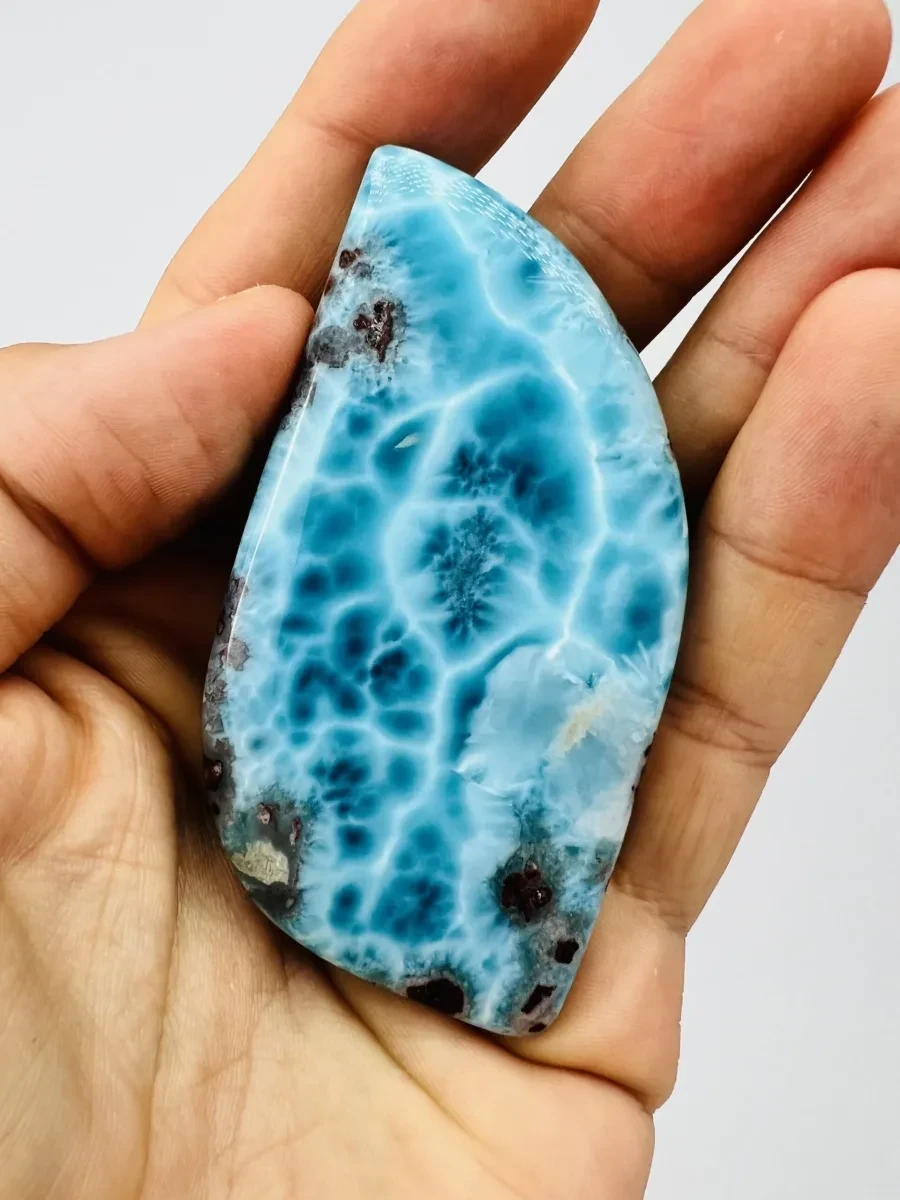
Larimar is the trade name for blue to blue-green gem material composed mainly of pectolite from the Dominican Republic. Pectolite is a sodium-calcium silicate mineral with the formula NaCa₂Si₃O₈(OH). It normally occurs in white, grey or colorless forms at localities around the world. The Dominican material is exceptional because compact, fibrous pectolite developed distinctive blue and green colors and can be cut and polished into jewellery, carvings and collector specimens.
The name Larimar refers to the Dominican gem material; it is not the formal name of a separate mineral species. In mineralogical terms, the principal mineral is pectolite, commonly intergrown with other phases such as calcite, natrolite, prehnite and chlorite.
Where is Larimar found?
The known deposit associated with Larimar lies in Barahona Province in the southwest of the Dominican Republic, in the area of Los Chupaderos, Los Checheses and Loma Filipina. Waterworn pieces were historically found downstream and near the coast, but the primary material occurs in the mountainous volcanic rocks inland.
Dominican law designated Larimar the country’s National Stone in 2011. The law describes the gem as occurring uniquely in the Dominican Republic. Modern scientific literature likewise treats Larimar as the Dominican blue gem-quality variety of pectolite.
Is Larimar a gemstone, a rock or a mineral?
All three words may appear in ordinary conversation, but they do not mean exactly the same thing.
- Pectolite is the mineral species.
- Larimar is the trade name for the Dominican blue gem material.
- A natural piece may contain more than pectolite. Associated minerals, matrix and small fractures can be part of the same specimen.
- Gemstone or gem material describes how suitable material is cut, polished, collected or worn.
Calling every visible feature an “impurity” oversimplifies the material. A polished piece may be a natural mineral aggregate whose visual character comes partly from the relationships between pectolite, associated minerals and host-rock remnants.
Why is Larimar blue?
For many years, copper was widely repeated as the main cause of Larimar’s blue color, partly because native copper and copper minerals can occur near Larimar. More recent analytical work found a stronger relationship between vanadium and blue areas, while higher iron was associated with greener areas. The researchers found very little copper inside the pectolite crystals they tested and no clear correlation between copper concentration and hue.
Chemistry is only part of the picture. Larimar commonly grows in radial bundles of fine fibres. Their orientation changes how light is transmitted and reflected, helping create dark blue centres, pale boundaries and the white wave-like structures for which the stone is known.
This is an active scientific story rather than a finished slogan. Different studies used different samples and techniques; responsible summaries should explain that evolution instead of continuing to photocopy the oldest explanation.
How did Larimar form?
Larimar did not simply cool from molten lava as a blue lump. The host rocks are volcanic, but the pectolite formed later through hydrothermal processes: hot to warm mineral-bearing fluids circulated through altered basalt, filling cavities and fractures as conditions changed.
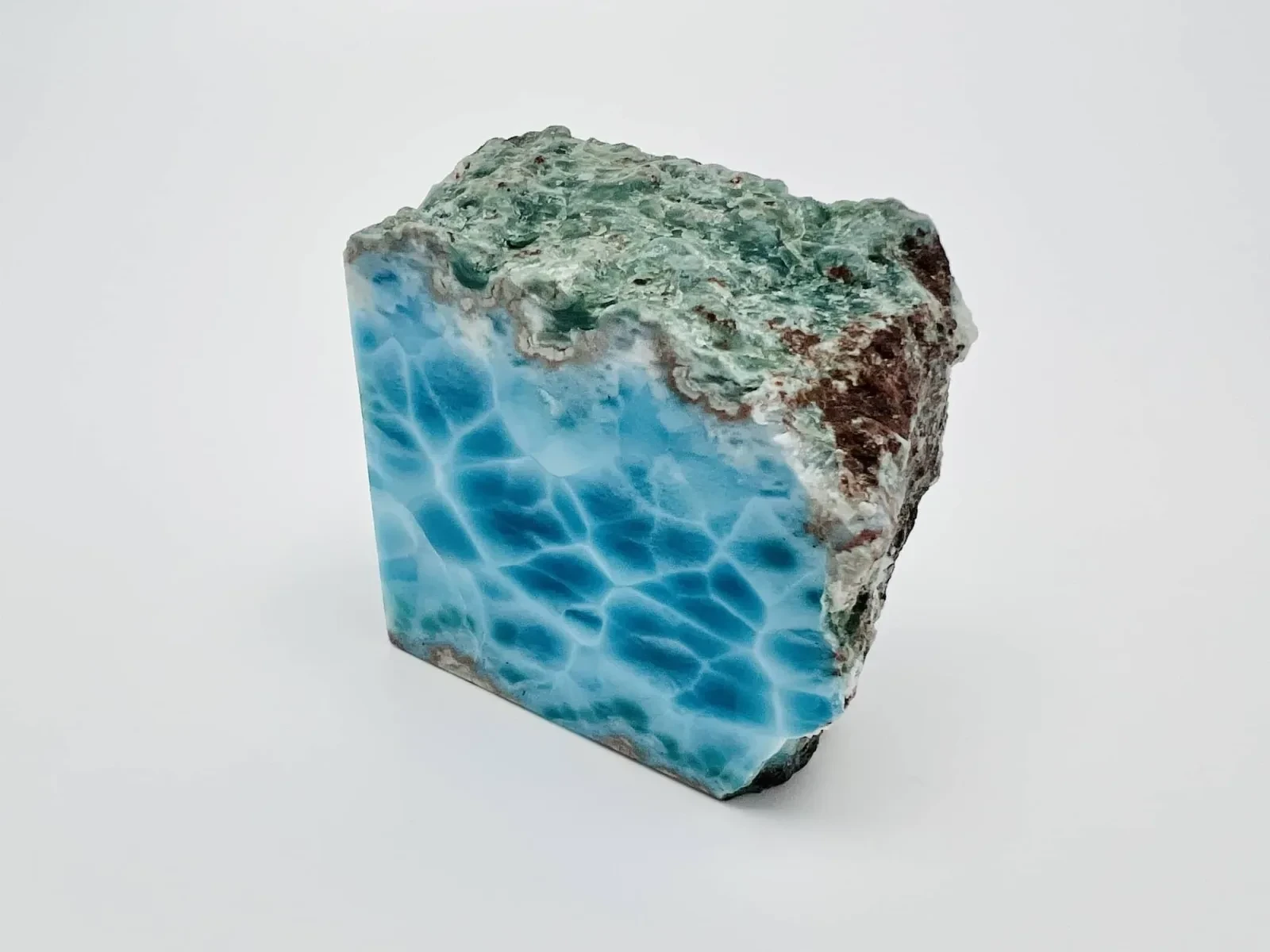
A 2024 mineralogical and geochemical study linked Larimar formation to low-temperature fluids below approximately 170°C, including fluids related to the volcanic rocks that later mixed with meteoric water. The studied bodies contained sequences of green, blue and white pectolite together with minerals such as natrolite, prehnite, calcite and chlorite.
What colors can Larimar show?
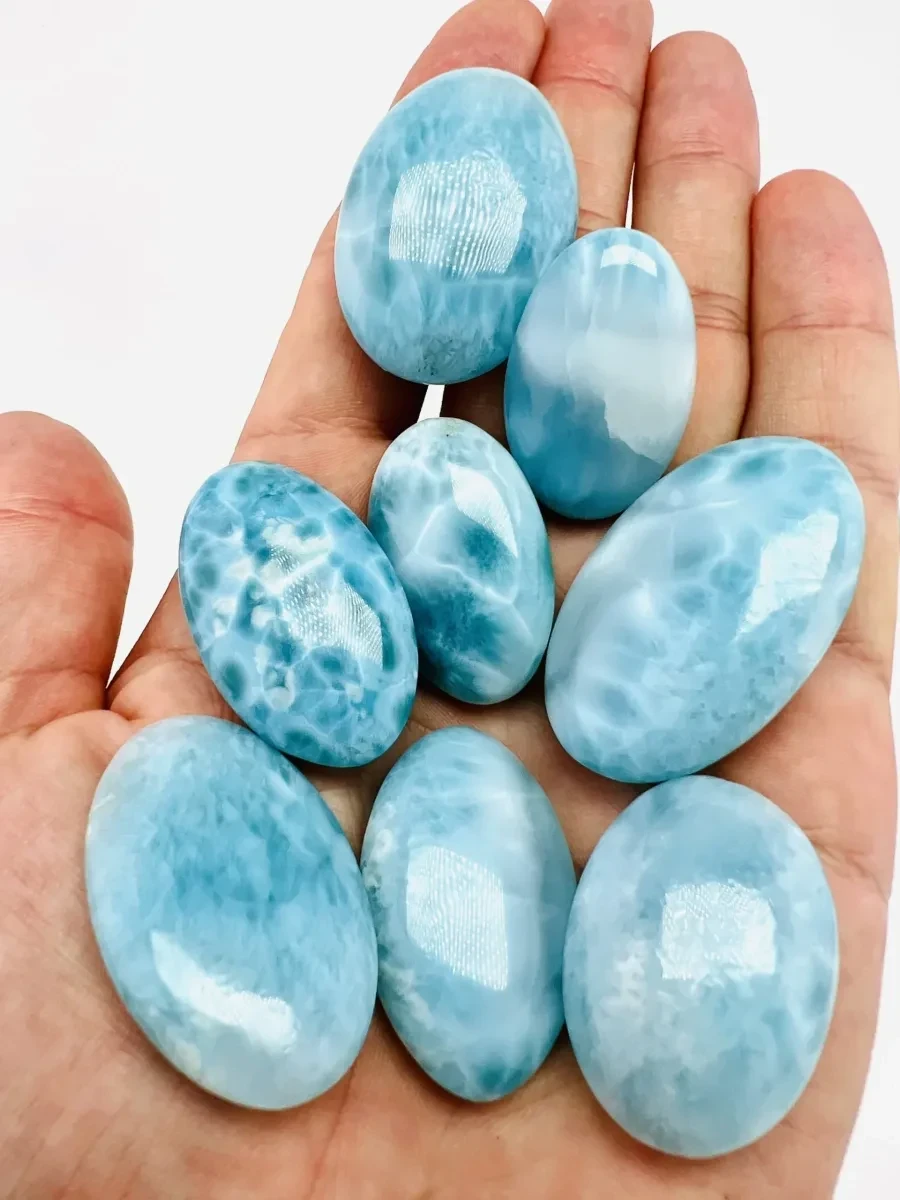
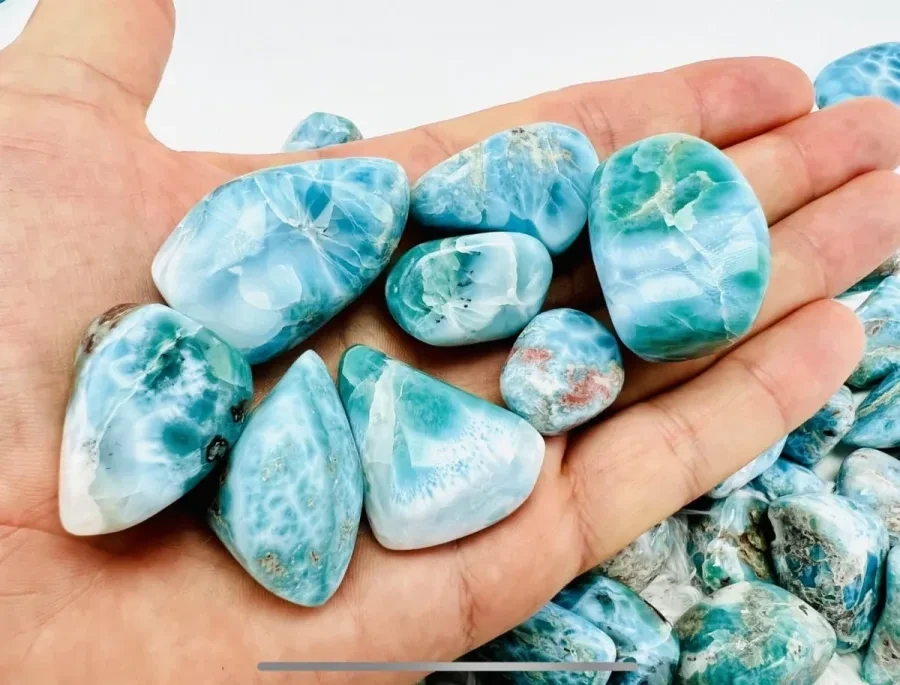
Larimar can range from nearly white with a faint blue cast to pale blue, sky blue, blue-green, turquoise-like blue and deep saturated blue. Green areas, white structures, red-brown hematite features, dark matrix and occasional native copper may also occur.
Color names used in trade are descriptive, not laboratory standards. Lighting, camera processing, screen calibration, stone thickness and polish can all alter the apparent color. A photograph is useful; a photograph is not a spectrometer with a holiday tan.
What is Larimar used for?
Compact material is fashioned into:
- Cabochons and jewellery stones
- Pendants, rings, earrings and bracelets
- Beads
- Palm stones and freeforms
- Carvings
- Spheres and display pieces
- Slabs and lapidary material
- Scientific and collector specimens
Its moderate hardness and variable internal structure mean that design and setting matter. Pendants and earrings are less exposed to impact than rings, while large carvings require careful orientation and structural assessment.
Why is Larimar considered rare?
Pectolite is not globally rare, but the blue Dominican material known as Larimar comes from a geographically restricted deposit. Within that deposit, strongly colored, visually attractive and structurally sound material represents only part of the recovered rock. Large clean pieces with unusual patterns or associated minerals can be much less common still.
Rarity should be described precisely. “Larimar is geographically restricted” is useful. “This is the rarest stone in the universe and your neighbour will regret not buying it by Tuesday” is not gemology.
Quick facts
- Principal mineral: Pectolite
- Formula: NaCa₂Si₃O₈(OH)
- Mineral group: Pyroxenoid; inosilicate
- Crystal system: Triclinic
- Typical habit in Larimar: Compact, fibrous and radial aggregates
- Typical Mohs hardness of pectolite: About 4.5–5
- Origin: Barahona Province, Dominican Republic
- Status in the Dominican Republic: National Stone since 2011
- Name: Traditionally explained as a combination of Larissa and mar, Spanish for sea
Continue exploring
Learn how Larimar formed, why its patterns appear, how it is authenticated and how to care for it.
Sources and further reading
- Huang, Hao-Ming; Shih, Yu-Hong; Chen, Huei-Fen; Lee, Hao-Yang; Fang, Jiann-Neng; Shen, Chuan-Chou; Yu, Bing-Sheng. “Revealing the Secrets behind the Color and Sea-Wave Patterns of Larimar.” *Minerals*, vol. 13, no. 9, 2023, article 1221. — link
- Dumańska-Słowik, Magdalena; Powolny, Tomasz; Milovský, Rastislav; Natkaniec-Nowak, Lucyna; George, Carlos; Lora, Eudalislao; Quezada, Daniel; Surmacki, Jakub. “Origin of bluish pectolite aka larimar from the Dominican Republic: Constraints from mineralogy and geochemistry.” *Journal of South American Earth Sciences*, vol. 141, 2024, article 104949. — link
- Woodruff, Robert E.; Fritsch, Emmanuel. “Blue Pectolite from the Dominican Republic.” *Gems & Gemology*, Winter 1989, vol. 25, no. 4, pp. 216–225. — link
- Dominican Republic, Law No. 296-11, designating Larimar as the National Stone of the Dominican Republic; Official Gazette No. 10647, 16 November 2011. — link
- “Pectolite: Mineral information, data and localities.” Mindat.org. — link
Keep exploring Open all 12 lessons 0/12 visited
- Lesson 01 What is Larimar?
- Lesson 02 The history of Larimar
- Lesson 03 Larimar geology and formation
- Lesson 04 Larimar mineralogy and physical properties
- Lesson 05 Why is Larimar blue?
- Lesson 06 Larimar patterns, inclusions and associated minerals
- Lesson 07 How to care for Larimar
- Lesson 08 Larimar and the Dominican Republic
- Lesson 09 Larimar symbolism and spiritual traditions
- Lesson 10 Larimar FAQ
- Lesson 11 Larimar glossary
- Lesson 12 How to read a Larimar specimen