Gemological reference Trade practice
How to care for Larimar
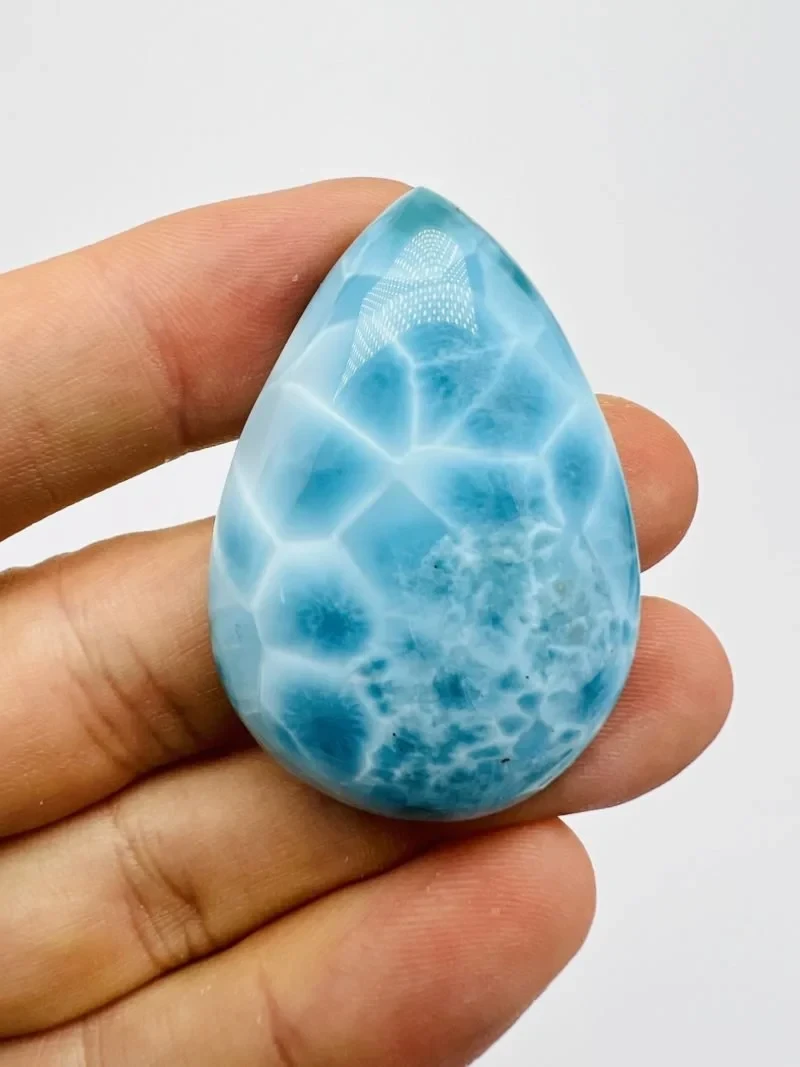
Larimar is durable enough for jewellery and polished objects, but it is not indestructible. Pectolite has a typical Mohs hardness of about 4.5–5, and natural Larimar may contain fibres, associated minerals, matrix and fractures that affect individual pieces.
The safest care is simple: gentle cleaning, separate storage and protection from impact and high heat.
Routine cleaning
- Use lukewarm water with a small amount of mild, non-abrasive soap.
- Wipe gently with a soft cloth or very soft brush.
- Rinse briefly with clean water.
- Dry completely with a soft lint-free cloth.
- Allow drilled holes, settings and cords to dry before storage.
Do not soak a piece for long periods unless its construction, adhesives and treatments are known.
Avoid ultrasonic and steam cleaners
Ultrasonic vibration can aggravate fractures, loosen inclusions or damage settings. Steam cleaners combine heat and pressure—two things Larimar did not request for its spa day.
Professional jewellers should inspect the stone and setting before using any mechanical cleaning method. The default recommendation is no ultrasonic and no steam.
Avoid high heat
Laboratory experiments have shown that extended heating around 250°C can reduce Larimar’s blue color. Jewellery repair torches reach much higher temperatures locally.
Remove Larimar before soldering whenever possible. If repair near the stone is unavoidable, the jeweller must understand heat-sensitive gem materials and use an appropriate protective method. Never test Larimar with a flame.
Chemicals and cosmetics
Keep Larimar away from:
- Bleach
- Strong acids or alkalis
- Abrasive cleaners
- Metal-polishing compounds applied directly to the stone
- Hair dye
- Solvents
- Unverified jewellery dips
Apply perfume, hairspray, sunscreen and cosmetics before putting on jewellery. After swimming in chlorinated water or the sea, rinse and dry the piece gently, especially if it contains silver, adhesives or porous cord.
Scratches and impact
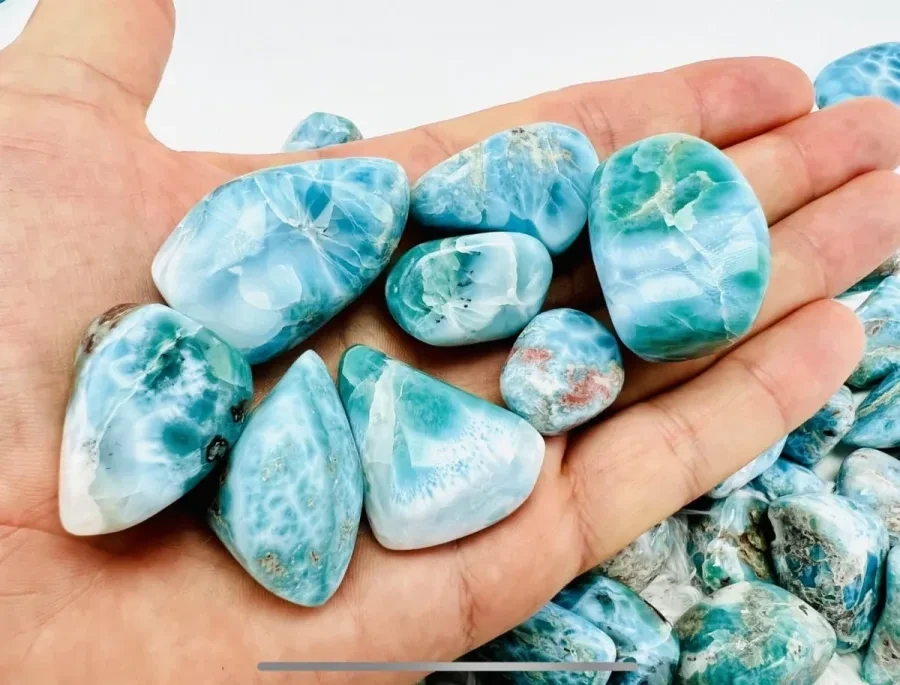
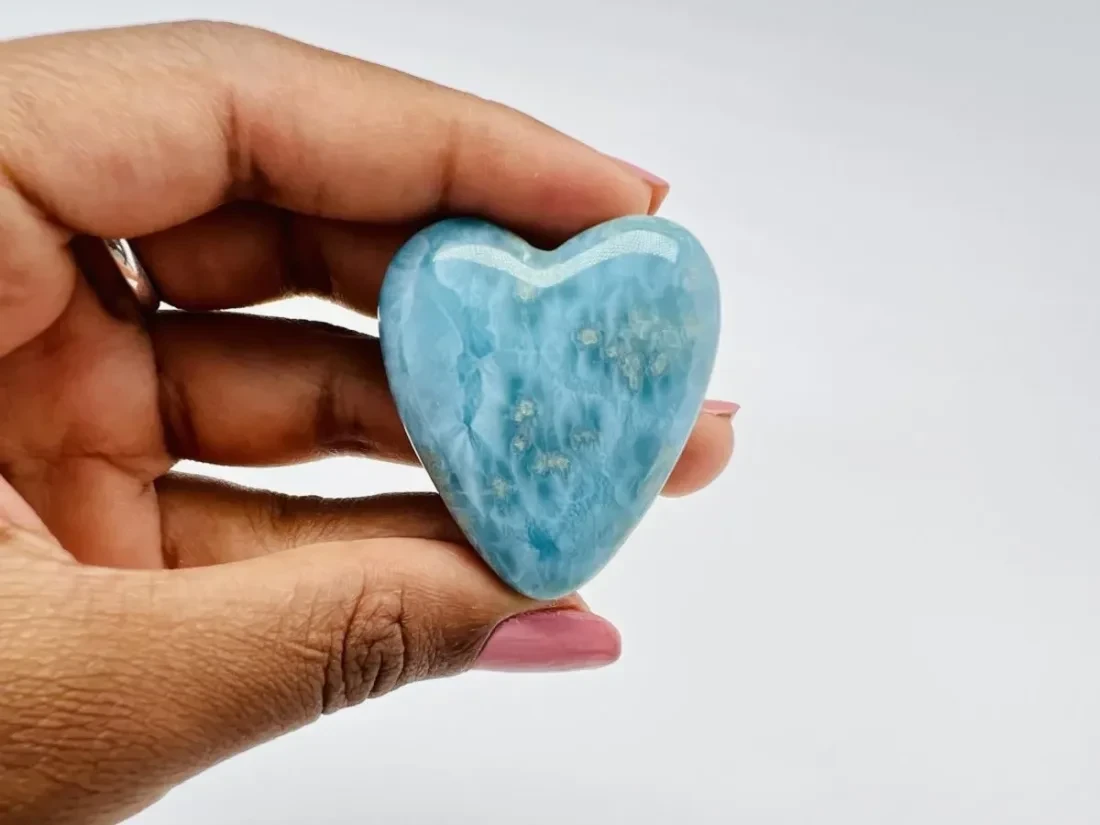
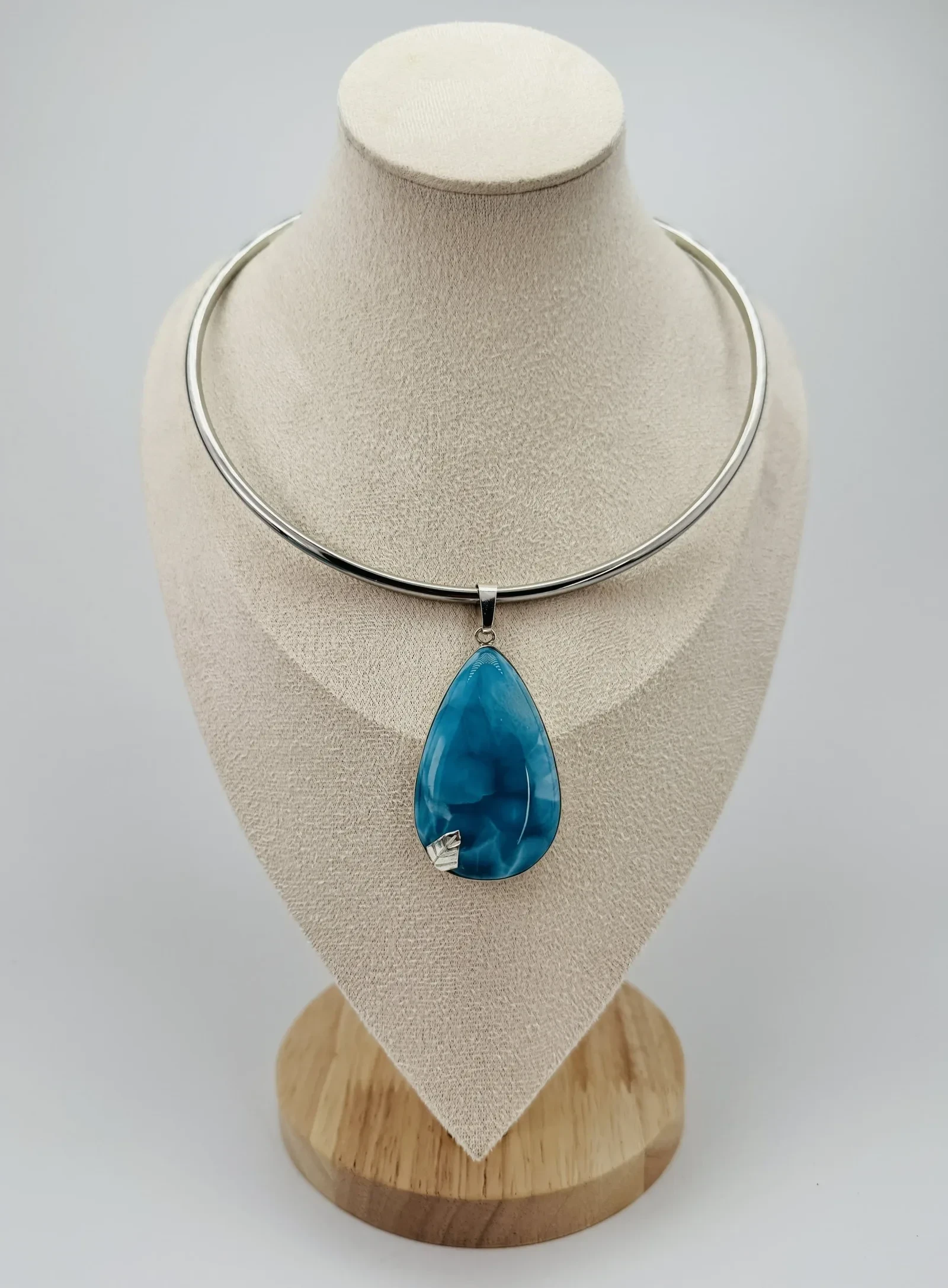
Store Larimar separately from harder gems and metal edges. Quartz, topaz, corundum and diamond can scratch it. A soft pouch or lined compartment is preferable to a shared jewellery box where every stone conducts its own tiny demolition project.
Rings and bracelets receive more impact than pendants and earrings. Remove Larimar rings before manual work, exercise, gardening, cleaning, lifting, or any activity in which the stone may strike a hard surface.
Sunlight and display
Normal brief daylight is not known to bleach Larimar instantly. A 1989 GIA test found no visible change after more than 50 hours of intense fibre-optic light in the tested sample. Long-term conditions and individual material vary, and heat is a demonstrated concern.
Do not leave Larimar for prolonged periods in hot vehicles, on radiators, under strong display lamps or in windows where heat builds up. For valuable specimens, stable indoor display conditions are sensible.
Silver and metal settings
Silver tarnish should be cleaned with care. Use a polishing cloth on the metal while avoiding aggressive rubbing of the stone. Liquid silver dips may affect adhesives, porous materials or surface treatments.
Inspect prongs, bezels, bails and drill holes periodically. Movement in a setting can turn a small mechanical issue into a very expensive lesson in gravity.
Rough and collector specimens
Do not remove matrix, iron staining, calcite or other associated material without understanding the specimen. Cleaning acids can destroy mineral associations and provenance value. Use only dry brushing or gentle water cleaning unless a qualified mineral preparator recommends otherwise.
Repairs and repolishing
Minor surface wear can sometimes be repolished by an experienced lapidary. Deep scratches, fractures, drilled-hole damage and loose inclusions require individual assessment. Any resin filling, stabilization or repair should be disclosed in future sale or documentation.
Care summary
- Clean with mild soap, lukewarm water and a soft cloth.
- Avoid steam, ultrasonic cleaning, flame and high heat.
- Protect from harder materials and sharp impact.
- Store separately.
- Inspect settings and drill holes.
- Ask a specialist before using chemicals or altering a specimen.
Sources and further reading
- “Pectolite: Mineral information, data and localities.” Mindat.org. — link
- Woodruff, Robert E.; Fritsch, Emmanuel. “Blue Pectolite from the Dominican Republic.” *Gems & Gemology*, Winter 1989, vol. 25, no. 4, pp. 216–225. — link
- Huang, Hao-Ming; Shih, Yu-Hong; Chen, Huei-Fen; Lee, Hao-Yang; Fang, Jiann-Neng; Shen, Chuan-Chou; Yu, Bing-Sheng. “Revealing the Secrets behind the Color and Sea-Wave Patterns of Larimar.” *Minerals*, vol. 13, no. 9, 2023, article 1221. — link
- Anthony, John W.; Bideaux, Richard A.; Bladh, Kenneth W.; Nichols, Monte C., eds. “Pectolite.” *Handbook of Mineralogy*, Mineral Data Publishing / Mineralogical Society of America, version 1.2. — link
Keep exploring Open all 12 lessons 0/12 visited
- Lesson 01 What is Larimar?
- Lesson 02 The history of Larimar
- Lesson 03 Larimar geology and formation
- Lesson 04 Larimar mineralogy and physical properties
- Lesson 05 Why is Larimar blue?
- Lesson 06 Larimar patterns, inclusions and associated minerals
- Lesson 07 How to care for Larimar
- Lesson 08 Larimar and the Dominican Republic
- Lesson 09 Larimar symbolism and spiritual traditions
- Lesson 10 Larimar FAQ
- Lesson 11 Larimar glossary
- Lesson 12 How to read a Larimar specimen