Peer-reviewed research Gemological reference
Larimar mineralogy and physical properties
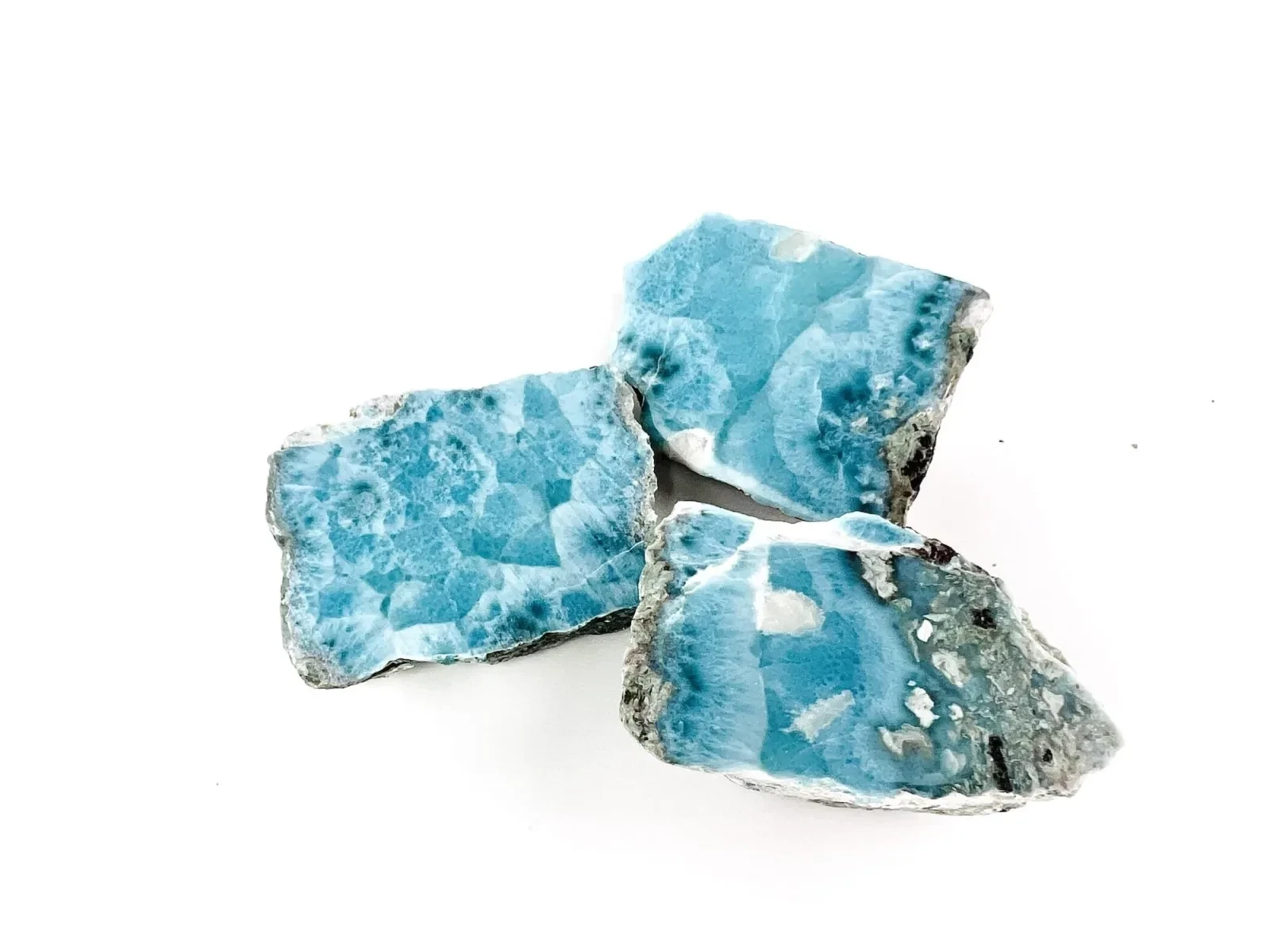
Larimar is a gem material composed mainly of pectolite, often intergrown with other minerals and small amounts of host-rock material. Understanding that composite character explains both its beauty and its practical limitations.
Mineral identity
- Trade name: Larimar
- Principal mineral: Pectolite
- Chemical formula: NaCa₂Si₃O₈(OH)
- Mineral class: Inosilicate
- Structural group: Pyroxenoid
- Crystal system: Triclinic
- Typical appearance in Larimar: Massive, compact, fibrous and radially arranged aggregates
Pectolite can form individual needle-like or prismatic crystals, but gem-quality Larimar is generally cut from compact aggregates rather than transparent facetable crystals.
Hardness is not the same as toughness
Pectolite is normally listed at approximately 4.5–5 on the Mohs scale. Mohs hardness describes resistance to scratching, not resistance to impact.
Compact fibrous Larimar can behave tougher than a single brittle crystal because many small fibres interrupt crack propagation. Early gemological scratch tests reported values above the standard pectolite range for some compact material. That does not justify advertising every piece as Mohs 6 or 7. Natural aggregates vary, scratch tests are destructive, and a higher apparent scratch resistance does not make a stone immune to chipping.
Practical conclusion: Larimar is suitable for jewellery and carvings, but it should be protected from abrasion and sharp impact.
Density and specific gravity
Reference data for Larimar and pectolite generally place specific gravity in the approximate range of 2.74–2.90. A natural piece containing calcite, matrix, pores or other minerals may fall outside a narrow textbook value.
Specific gravity can support identification, but it is not a standalone answer. Several look-alikes overlap in density, and mounted jewellery may be difficult to test accurately.
Refractive index
Pectolite is optically biaxial, with reference refractive indices broadly around 1.59–1.64 depending on crystallographic direction. Massive fibrous material is commonly tested with a spot reading rather than as a neatly oriented single crystal.
Laboratory results must be interpreted together with microscopy, density, spectroscopy and context. One number rarely walks into the room wearing a badge that says “case closed.”
Transparency and lustre
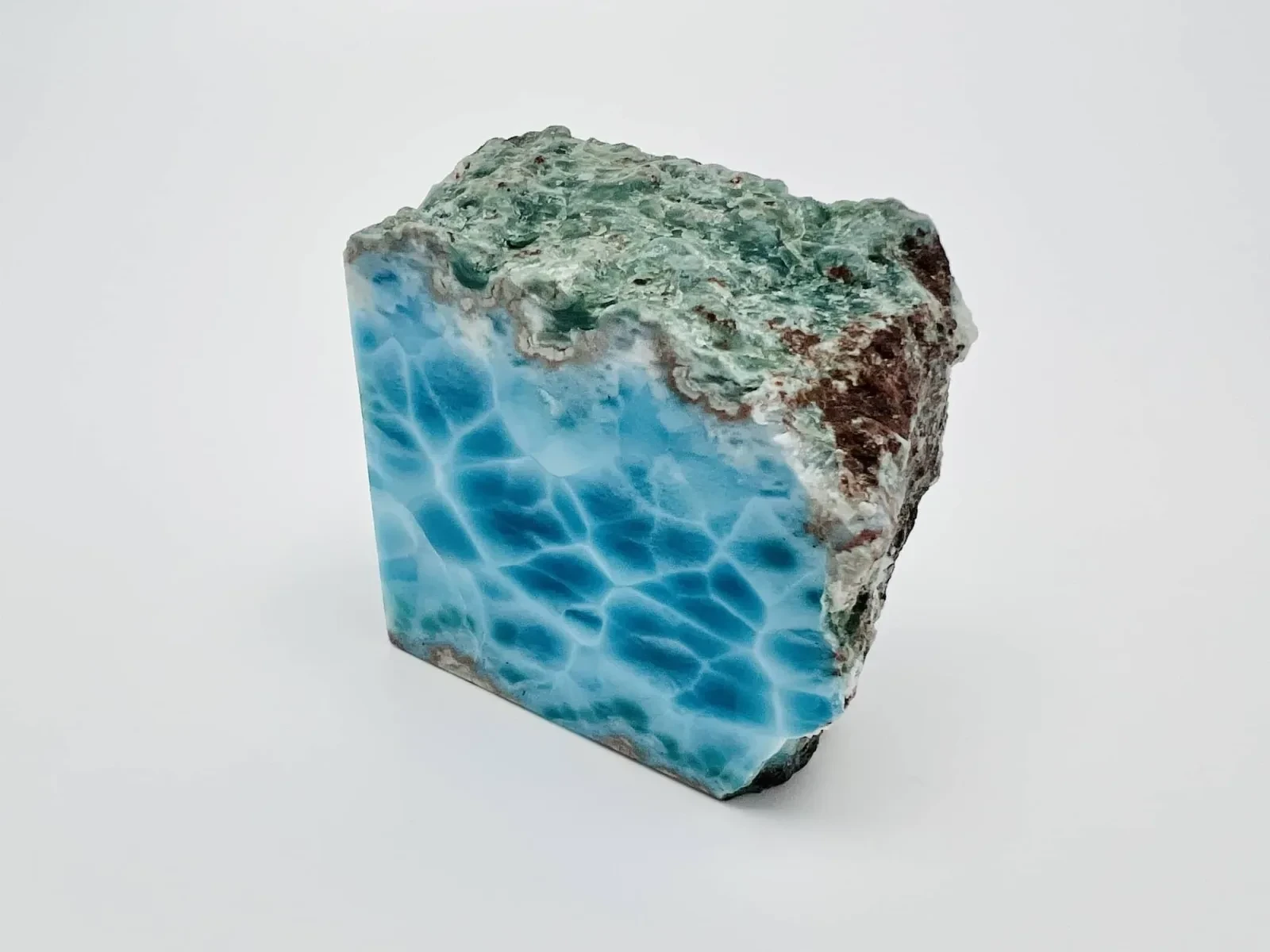
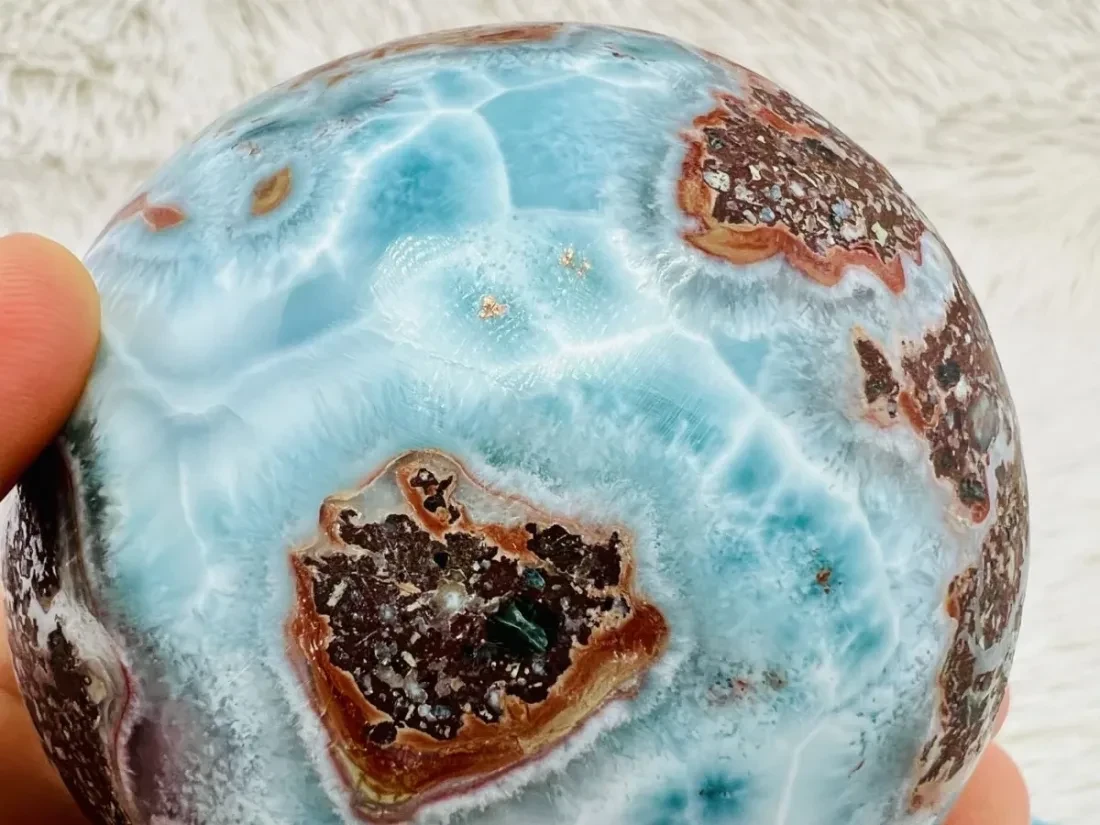
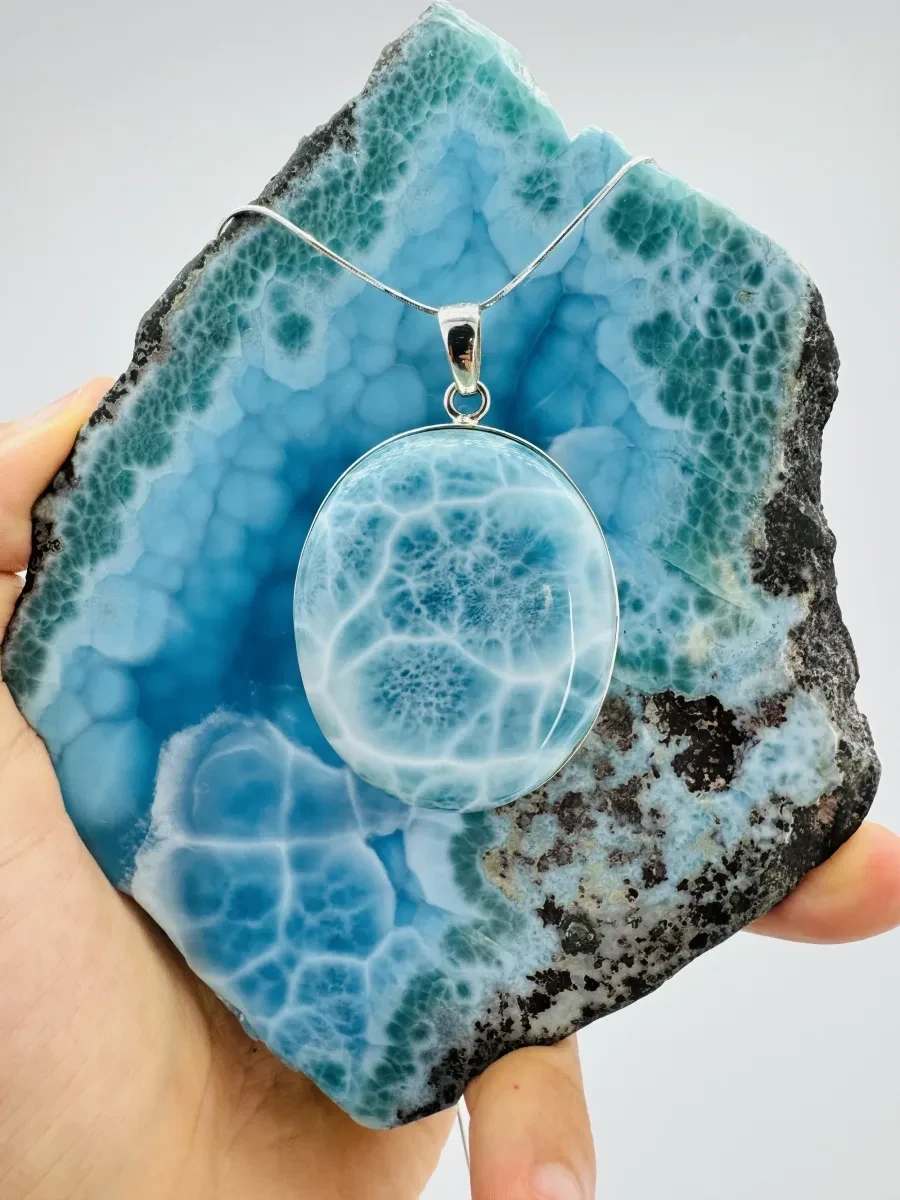
Larimar is usually opaque to translucent. Thin edges or strongly compact blue areas may transmit more light. Polished surfaces can show a silky to subvitreous lustre, while fibrous orientation can create visual depth and directional changes in brightness.
Translucency can contribute to beauty and value, but it should not be confused with transparency. Larimar is generally fashioned as a cabochon, bead, carving or freeform rather than faceted like a transparent gemstone.
Cleavage, fracture and internal structure
Pectolite has cleavage at the crystal level and is brittle as a mineral. In natural Larimar, durability is also controlled by:
- Fibre orientation
- Grain boundaries
- Existing fractures
- Calcite or other mineral zones
- Host-rock matrix
- Weathering
- Thickness and shape
- Drilling or setting stress
A polished piece may look clean from the front while containing a plane of weakness at the side or back. Structural inspection should therefore be part of grading and workmanship assessment.
Associated minerals
Research has documented Larimar intergrown with minerals including:
- Calcite
- Natrolite
- Prehnite
- Chlorite
- Hematite
- Native copper in some associations
Not every white feature is calcite, not every dark feature is “volcanic ash,” and not every red mark is automatically iron oxide without examination. Visual description and mineral identification are different levels of certainty.
Safe interpretation
Do not use scratch tests, acids, flame or uncontrolled heating on a valued specimen. These methods can damage the stone and still produce an ambiguous answer. Non-destructive gemological testing or laboratory analysis is the sensible route when identity matters.
Sources and further reading
- “Pectolite: Mineral information, data and localities.” Mindat.org. — link
- Woodruff, Robert E.; Fritsch, Emmanuel. “Blue Pectolite from the Dominican Republic.” *Gems & Gemology*, Winter 1989, vol. 25, no. 4, pp. 216–225. — link
- Dumańska-Słowik, Magdalena; Powolny, Tomasz; Milovský, Rastislav; Natkaniec-Nowak, Lucyna; George, Carlos; Lora, Eudalislao; Quezada, Daniel; Surmacki, Jakub. “Origin of bluish pectolite aka larimar from the Dominican Republic: Constraints from mineralogy and geochemistry.” *Journal of South American Earth Sciences*, vol. 141, 2024, article 104949. — link
- Huang, Hao-Ming; Shih, Yu-Hong; Chen, Huei-Fen; Lee, Hao-Yang; Fang, Jiann-Neng; Shen, Chuan-Chou; Yu, Bing-Sheng. “Revealing the Secrets behind the Color and Sea-Wave Patterns of Larimar.” *Minerals*, vol. 13, no. 9, 2023, article 1221. — link
- Anthony, John W.; Bideaux, Richard A.; Bladh, Kenneth W.; Nichols, Monte C., eds. “Pectolite.” *Handbook of Mineralogy*, Mineral Data Publishing / Mineralogical Society of America, version 1.2. — link
Keep exploring Open all 12 lessons 0/12 visited
- Lesson 01 What is Larimar?
- Lesson 02 The history of Larimar
- Lesson 03 Larimar geology and formation
- Lesson 04 Larimar mineralogy and physical properties
- Lesson 05 Why is Larimar blue?
- Lesson 06 Larimar patterns, inclusions and associated minerals
- Lesson 07 How to care for Larimar
- Lesson 08 Larimar and the Dominican Republic
- Lesson 09 Larimar symbolism and spiritual traditions
- Lesson 10 Larimar FAQ
- Lesson 11 Larimar glossary
- Lesson 12 How to read a Larimar specimen