Peer-reviewed research Trade practice
Larimar patterns, inclusions and associated minerals
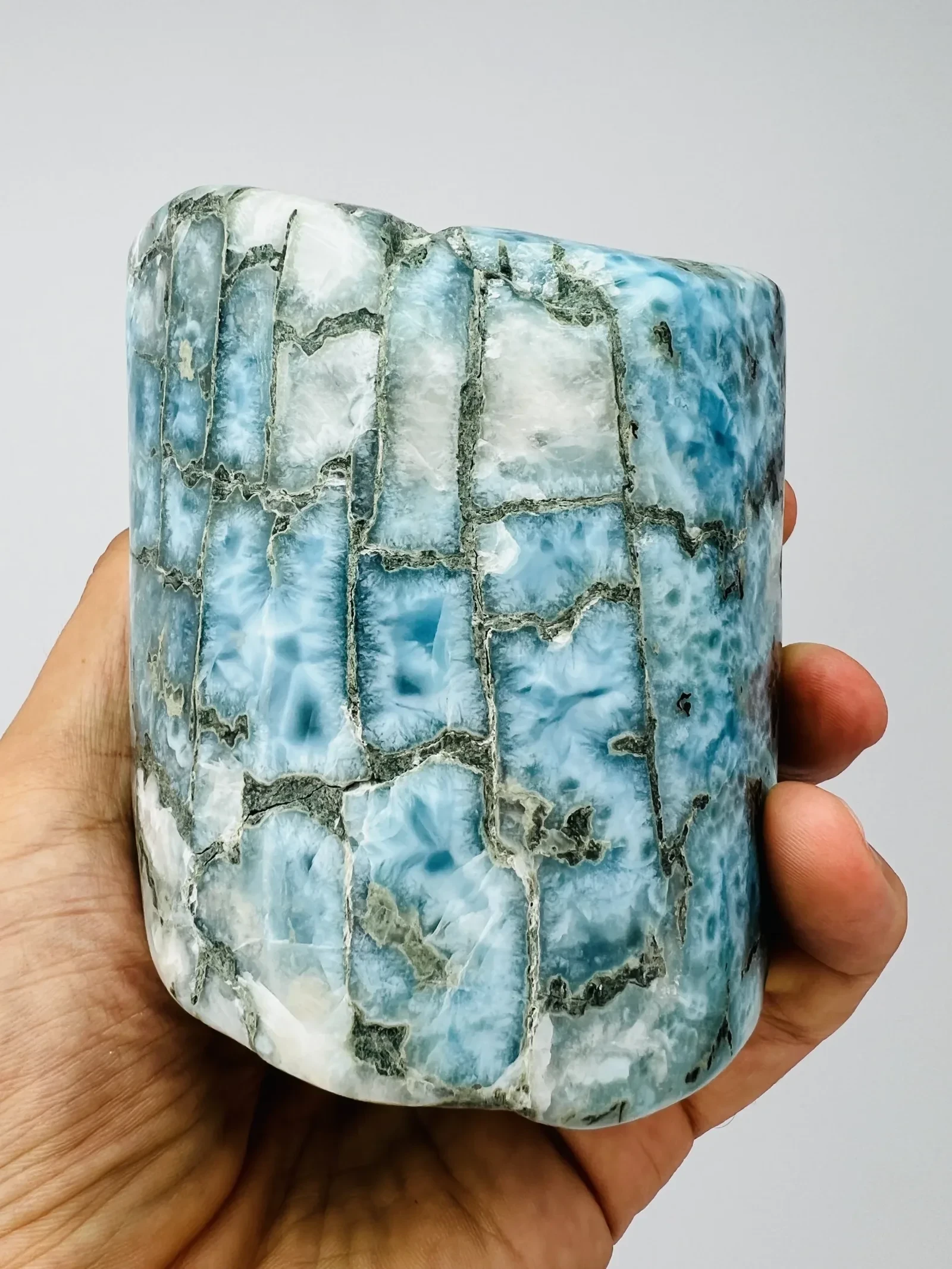
A Larimar pattern can be scientifically meaningful, commercially descriptive or simply visually memorable. Problems begin when those three categories are treated as identical.
Radial growth and the sea-wave pattern
Pectolite commonly grows as fine fibres arranged in radiating bundles or spherulitic forms. The boundaries between differently oriented bundles reflect and transmit light differently, creating pale lines, blue centres and wave-like structures.
The familiar “ocean” appearance is therefore connected to crystal growth and optics. It is not evidence that the stone formed in seawater, and it is not a reliable authentication test by itself.
Scientific structures and trade names
Some words describe observable mineral structures. Others are trade vocabulary developed to help collectors and customers compare appearances.
Structurally descriptive terms
- Radial: Fibres spread outward from a centre.
- Spherulitic: Rounded aggregate built from radiating crystals or fibres.
- Vein: Mineral filling a fracture or elongated opening.
- Amygdale: A mineral-filled cavity in volcanic rock.
- Matrix: Host or associated rock remaining with the gem material.
Common trade terms
- Ocean or sea-wave: Strong blue-and-white contrast resembling water.
- Turtleback: A network of rounded or polygonal blue cells separated by pale lines.
- Flat blue: Relatively uniform blue with little visible white pattern.
- Fractal: A Larimar Miner descriptor for branching or repeatedly subdividing visual structures. It is not a formal mineralogical term.
- Angelic: A trade descriptor for light, soft blue-white material. It is not a mineral variety.
A trade name is useful when it is defined consistently. Without reference images and criteria, it becomes a poetic hat placed on whichever stone needs a name that afternoon.
White areas
White features may result from more than one cause:
- Optical scattering at boundaries between fibrous bundles
- White pectolite
- Calcite
- Natrolite
- Other pale associated phases
- Fractures or surface reflections
Visual inspection can suggest an explanation but may not establish mineral identity.
Red and brown features
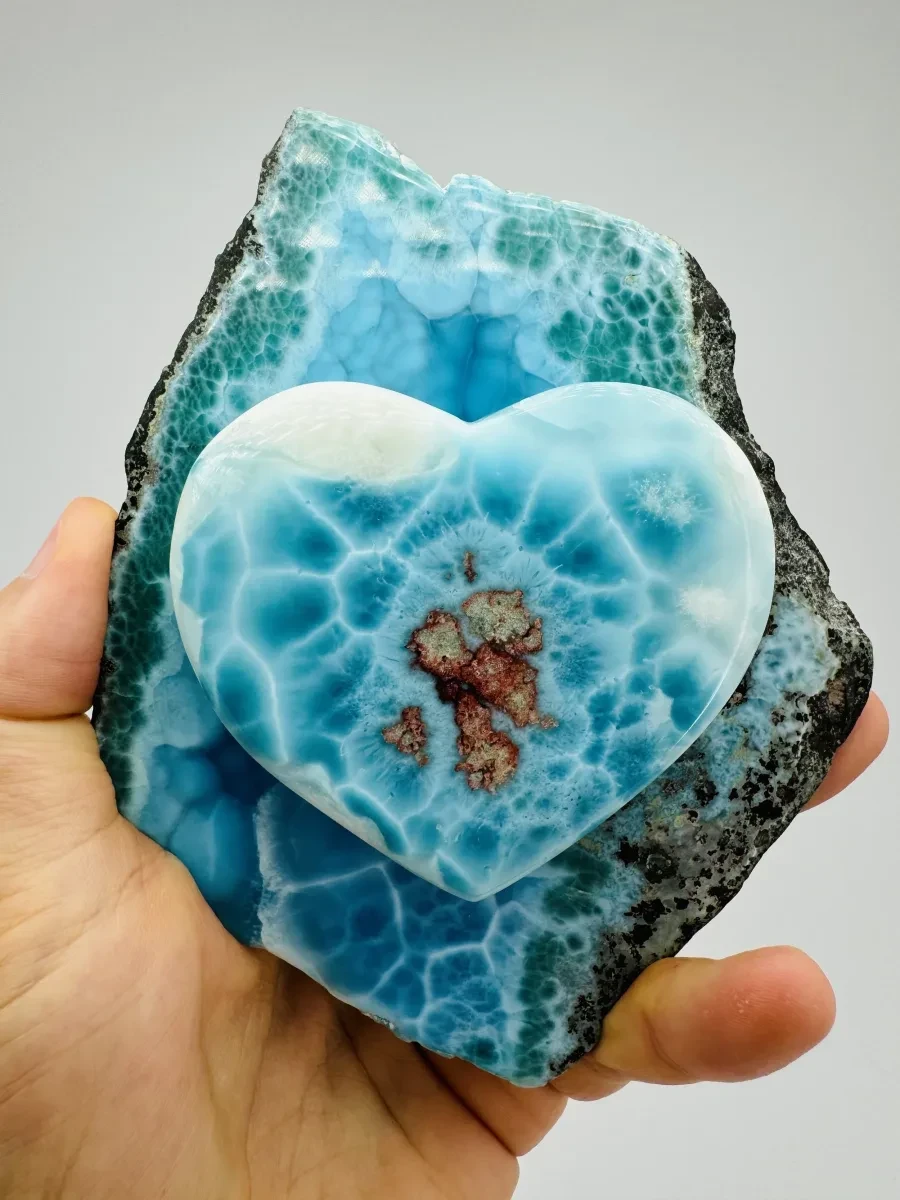
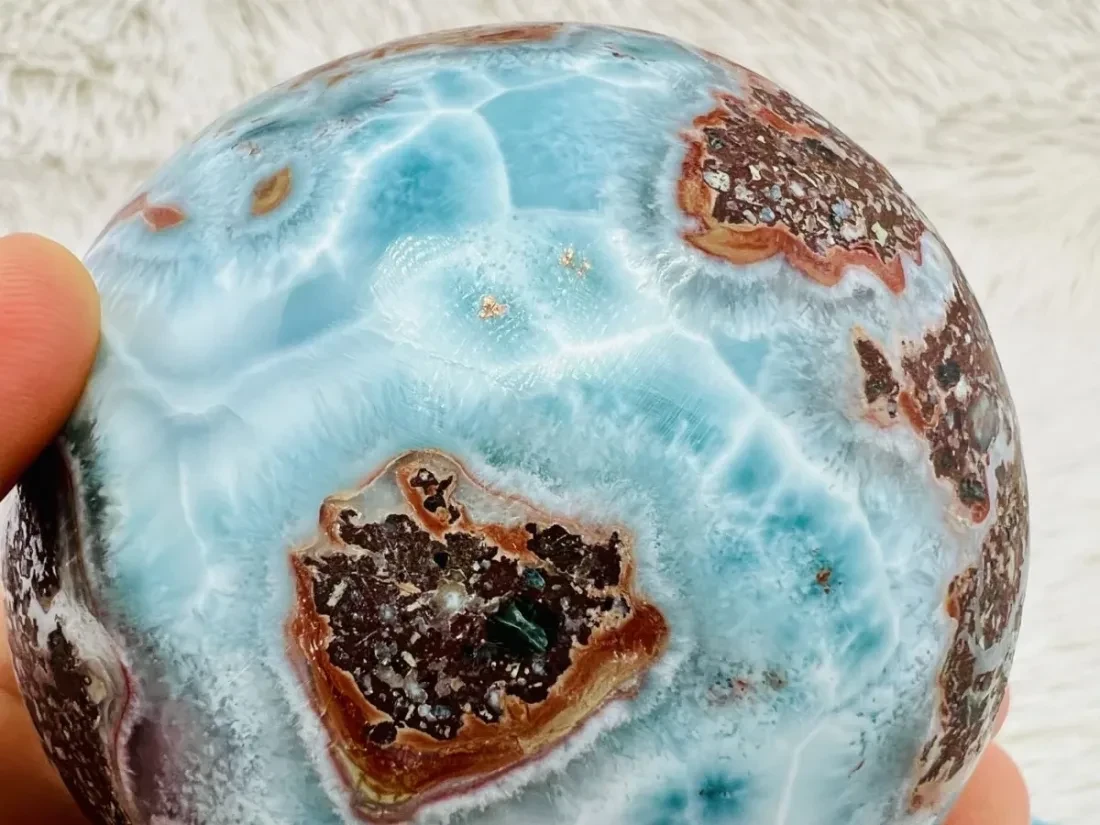
Older GIA work identified some red dendritic features as hematite. Iron oxides can create red-brown lines, plumes or staining in altered volcanic material.
“Dendritic” describes branching appearance; it does not identify a mineral by itself. Similar shapes can be produced by different minerals and growth processes.
Dark and green material
Dark areas may include host-rock matrix, chlorite-rich alteration, iron-bearing minerals, weathered material or fractures filled with secondary phases. Green pectolite may be part of the Larimar body itself and is not automatically waste or low grade.
The role of a feature depends on the purpose of the piece. A clean jewellery cabochon and a scientifically interesting mineral association are judged by different criteria.
Native copper
Native copper can occur in the deposit and may be present as metallic inclusions or associated material. Genuine natural copper-bearing Larimar is visually striking, but metallic appearance alone does not prove native copper. Oxidation, stability and structural effects should be examined, and any treatment or added metal must be disclosed.
Fractures and healed structures
Natural fractures are common in geological material. Some are open and reduce durability; others are mineral-filled or stable. A fracture should be assessed for:
- Depth
- Direction
- Whether it reaches an edge or drilled hole
- Movement under light pressure
- Surface opening
- Effect on polishing
- Effect on setting or wear
Filling, resin stabilization or repair must be disclosed. A polished surface can make a fracture less visible without making it disappear from the laws of mechanics.
How the Pattern Atlas is organized
Our Pattern Atlas separates:
- Mineralogical structures
- Associated minerals and matrix
- Trade pattern names
- Larimar Miner proprietary descriptors
- Uncertain or pending identifications
Every entry should include standardized photographs, scale, lighting notes, specimen orientation and the level of confidence behind the description.
Sources and further reading
- Huang, Hao-Ming; Shih, Yu-Hong; Chen, Huei-Fen; Lee, Hao-Yang; Fang, Jiann-Neng; Shen, Chuan-Chou; Yu, Bing-Sheng. “Revealing the Secrets behind the Color and Sea-Wave Patterns of Larimar.” *Minerals*, vol. 13, no. 9, 2023, article 1221. — link
- Dumańska-Słowik, Magdalena; Powolny, Tomasz; Milovský, Rastislav; Natkaniec-Nowak, Lucyna; George, Carlos; Lora, Eudalislao; Quezada, Daniel; Surmacki, Jakub. “Origin of bluish pectolite aka larimar from the Dominican Republic: Constraints from mineralogy and geochemistry.” *Journal of South American Earth Sciences*, vol. 141, 2024, article 104949. — link
- Woodruff, Robert E.; Fritsch, Emmanuel. “Blue Pectolite from the Dominican Republic.” *Gems & Gemology*, Winter 1989, vol. 25, no. 4, pp. 216–225. — link
- Espí, J. A. “Estudio de fibras y colores del Larimar Dominicano / Study of fibers and colours in Dominican Larimar.” *Boletín Geológico y Minero*, vol. 128, no. 3, 2017, pp. 783–801. — link
Keep exploring Open all 12 lessons 0/12 visited
- Lesson 01 What is Larimar?
- Lesson 02 The history of Larimar
- Lesson 03 Larimar geology and formation
- Lesson 04 Larimar mineralogy and physical properties
- Lesson 05 Why is Larimar blue?
- Lesson 06 Larimar patterns, inclusions and associated minerals
- Lesson 07 How to care for Larimar
- Lesson 08 Larimar and the Dominican Republic
- Lesson 09 Larimar symbolism and spiritual traditions
- Lesson 10 Larimar FAQ
- Lesson 11 Larimar glossary
- Lesson 12 How to read a Larimar specimen