Larimar FAQ
Is Larimar a mineral?
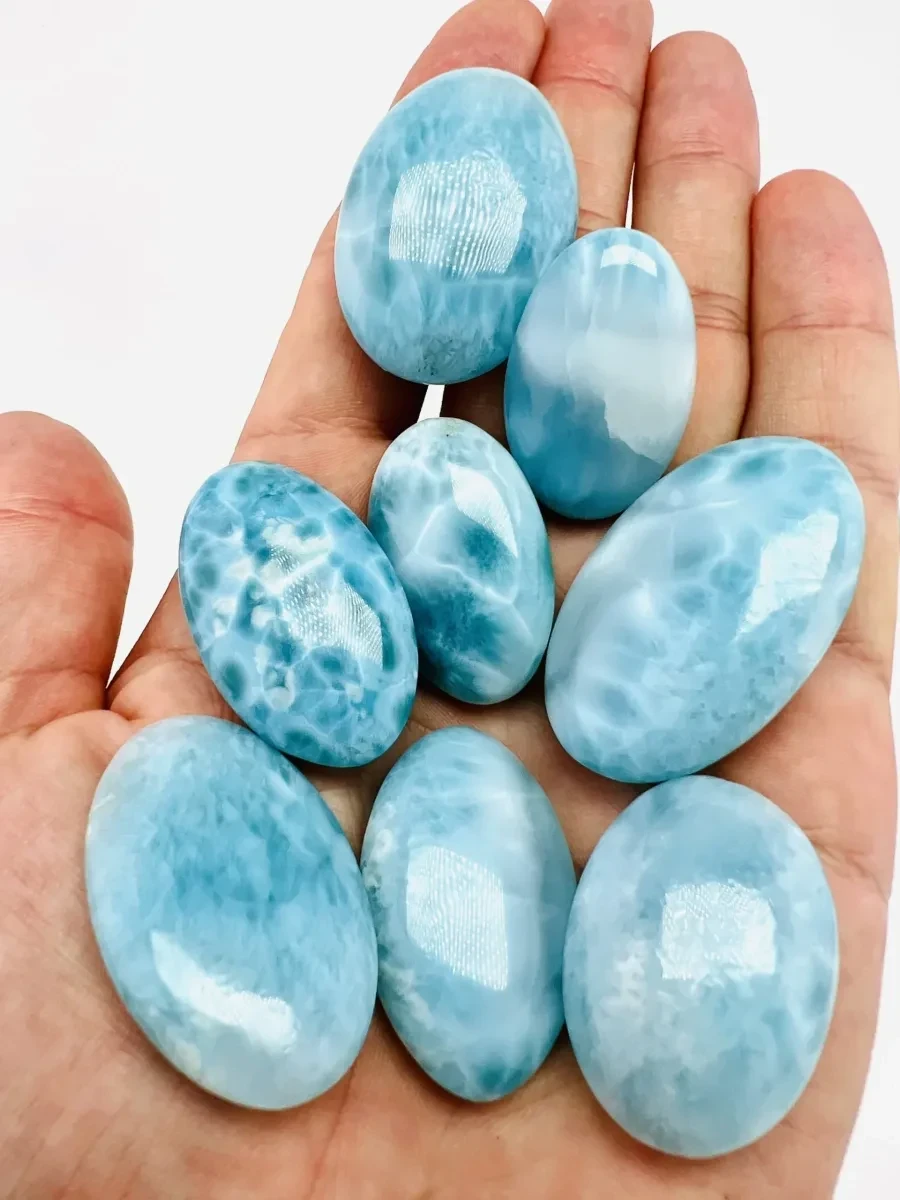
Larimar is a trade name for Dominican blue to blue-green gem material composed mainly of the mineral pectolite. Pectolite is the mineral species; Larimar is the geographic and commercial name for the distinctive Dominican material.
Where is Larimar found?
The known deposit associated with Larimar is in Barahona Province in the southwest of the Dominican Republic. Waterworn material has also been found downstream and near the coast after erosion transported it from the primary source.
Is Larimar found anywhere else?
Pectolite occurs in many countries, but the blue gem material known as Larimar is associated with the Dominican Republic. Claims of “Larimar” from another country require exceptional evidence and may describe a look-alike or another pectolite occurrence rather than recognized Larimar.
Why is Larimar blue?
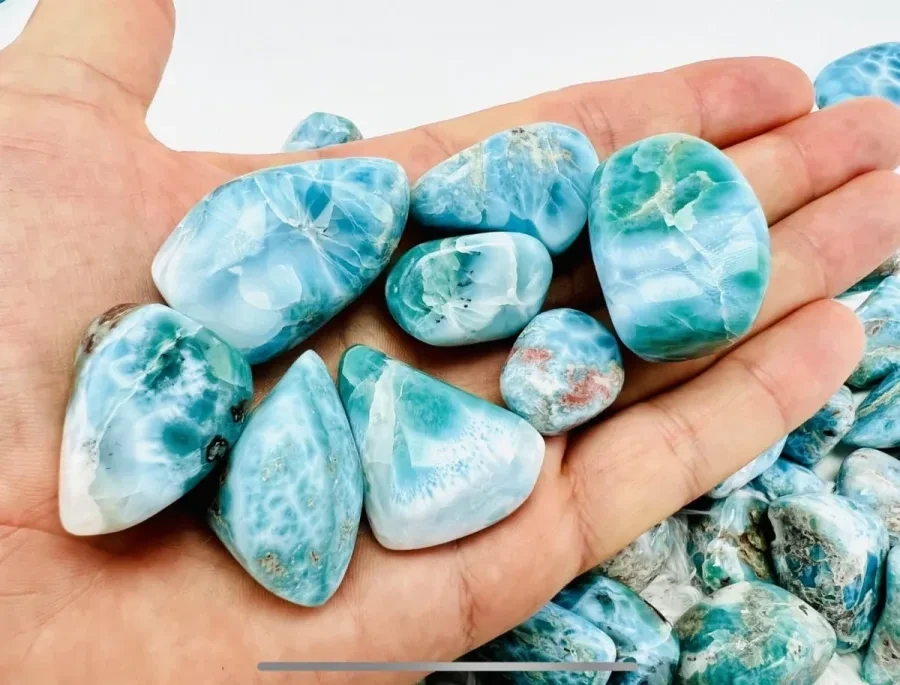
Current research links blue color mainly with vanadium in the pectolite structure and greener tones with higher iron. Fibrous crystal orientation also changes the apparent color and creates pale wave-like boundaries. Copper may occur nearby but is not supported as the single universal cause of blue.
Is Larimar the same as turquoise?
No. Turquoise and pectolite are different minerals with different chemistry and structure. Some Larimar colors resemble turquoise, but resemblance is not identity.
How hard is Larimar?
Pectolite is normally about 4.5–5 on the Mohs hardness scale. Compact fibrous material may be relatively tough, but Larimar can still scratch, chip or break, especially along fractures.
Can Larimar be worn every day?
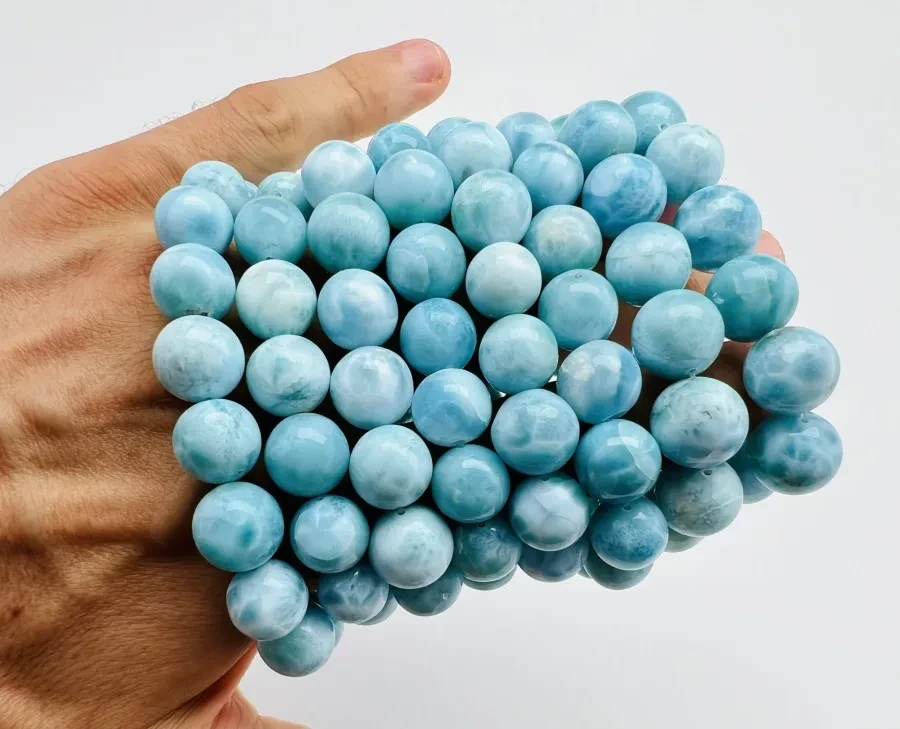
It can be worn regularly with sensible care. Pendants and earrings are less exposed than rings and bracelets. Remove Larimar jewellery during manual work, sport, cleaning and activities involving impact or abrasion.
Can Larimar get wet?
Brief contact with clean water is usually acceptable for untreated stone, but jewellery may contain silver, adhesives, cord or treatments that need additional care. Avoid prolonged soaking and dry the piece completely.
Does Larimar fade in sunlight?
Normal brief daylight is not known to cause instant fading. Heat is a clearer concern: laboratory heating has reduced blue color. Avoid prolonged exposure to hot windows, vehicles, strong lamps, steam and repair torches.
How can I tell whether Larimar is genuine?
No single photograph or pattern proves identity. Begin with provenance and seller documentation, then consider microscopy, density and refractive testing. Valuable or disputed material may require Raman spectroscopy, X-ray diffraction or another professional laboratory method.
What are common Larimar look-alikes?
Blue calcite or aragonite sold under Caribbean trade names, dyed howlite or magnesite, turquoise, chrysocolla, glass, resin and reconstructed composites can resemble aspects of Larimar.
Is there an official universal Larimar grade?
No widely accepted international grading standard governs all Larimar. Sellers may use A, AA, AAA, “super blue” and specialty names differently. Ask for criteria, photographs, measurements and treatment disclosure.
What makes Larimar valuable?
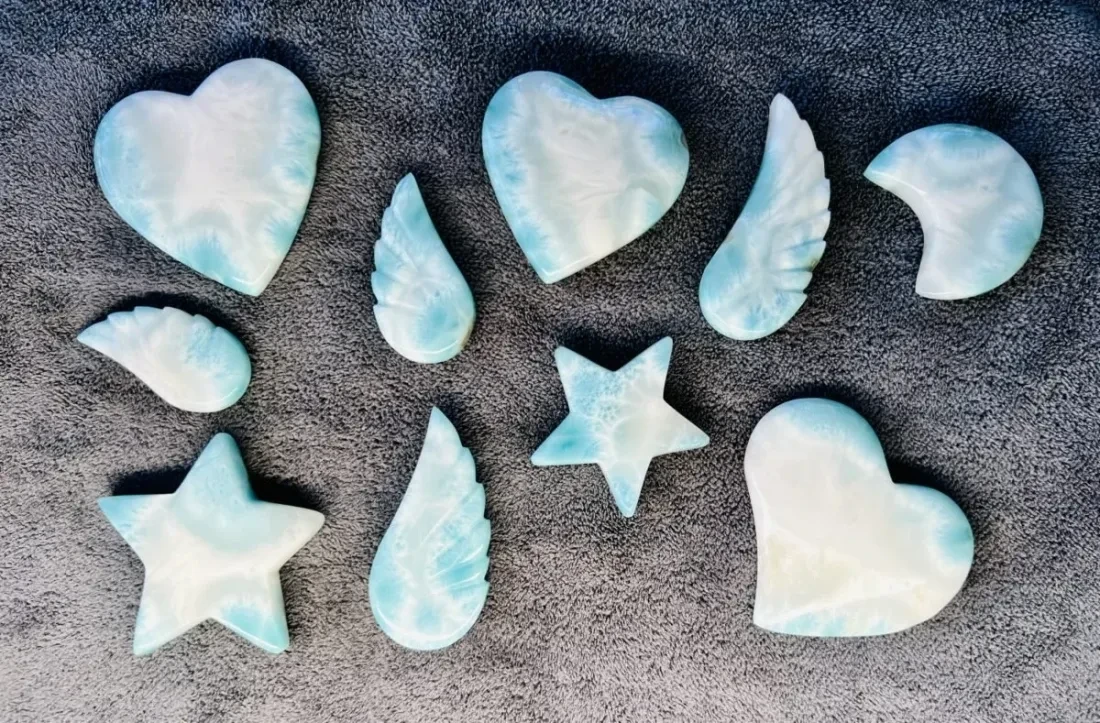
Value is influenced by color, pattern, contrast, structural integrity, translucency, size, rarity of features, cut, polish, workmanship, provenance and market demand. Weight alone is not enough.
Is darker blue always better?
Strong saturated blue is often valued, but it is not the only desirable character. Pattern, structural condition, optical depth, unusual associated minerals and excellent workmanship may matter just as much. Personal preference remains legitimate; the grading police will not arrive by boat.
Is Larimar rare?
The geographic occurrence is restricted, and fine usable material represents only part of what is extracted. “Rare” should still be used precisely because ordinary commercial pieces and exceptional collector specimens are not equally scarce.
Is Larimar the National Stone of the Dominican Republic?
Yes. Law 296-11 designated Larimar the National Stone in 2011. Law 17-18 later established 22 November as National Larimar Day.
Does Larimar have healing powers?
There is no reliable clinical evidence that Larimar treats disease, regulates hormones, lowers blood pressure or replaces medical care. People may value it symbolically or use it during personal spiritual practices, but those beliefs should not be presented as medical fact.
Can raw Larimar be exported from the Dominican Republic?
Extraction, processing and export are regulated, and the rules have changed over time. Obtain current instructions from the Dominican Ministry of Energy and Mines and customs authorities rather than relying on an old blog post or historical resolution.
How should Larimar be cleaned?
Use lukewarm water, mild soap and a soft cloth. Avoid ultrasonic cleaners, steam, strong chemicals, abrasive compounds and high heat.
Sources and further reading
- Huang, Hao-Ming; Shih, Yu-Hong; Chen, Huei-Fen; Lee, Hao-Yang; Fang, Jiann-Neng; Shen, Chuan-Chou; Yu, Bing-Sheng. “Revealing the Secrets behind the Color and Sea-Wave Patterns of Larimar.” *Minerals*, vol. 13, no. 9, 2023, article 1221. — link
- Dumańska-Słowik, Magdalena; Powolny, Tomasz; Milovský, Rastislav; Natkaniec-Nowak, Lucyna; George, Carlos; Lora, Eudalislao; Quezada, Daniel; Surmacki, Jakub. “Origin of bluish pectolite aka larimar from the Dominican Republic: Constraints from mineralogy and geochemistry.” *Journal of South American Earth Sciences*, vol. 141, 2024, article 104949. — link
- Dominican Republic, Law No. 296-11, designating Larimar as the National Stone of the Dominican Republic; Official Gazette No. 10647, 16 November 2011. — link
- Dominican Republic, Law No. 17-18, declaring 22 November of each year the National Day of Larimar; Official Gazette No. 10909, 23 April 2018. — link
- Woodruff, Robert E.; Fritsch, Emmanuel. “Blue Pectolite from the Dominican Republic.” *Gems & Gemology*, Winter 1989, vol. 25, no. 4, pp. 216–225. — link
- “Pectolite: Mineral information, data and localities.” Mindat.org. — link
Keep exploring Open all 12 lessons 0/12 visited
- Lesson 01 What is Larimar?
- Lesson 02 The history of Larimar
- Lesson 03 Larimar geology and formation
- Lesson 04 Larimar mineralogy and physical properties
- Lesson 05 Why is Larimar blue?
- Lesson 06 Larimar patterns, inclusions and associated minerals
- Lesson 07 How to care for Larimar
- Lesson 08 Larimar and the Dominican Republic
- Lesson 09 Larimar symbolism and spiritual traditions
- Lesson 10 Larimar FAQ
- Lesson 11 Larimar glossary
- Lesson 12 How to read a Larimar specimen