Peer-reviewed research
Why is Larimar blue?
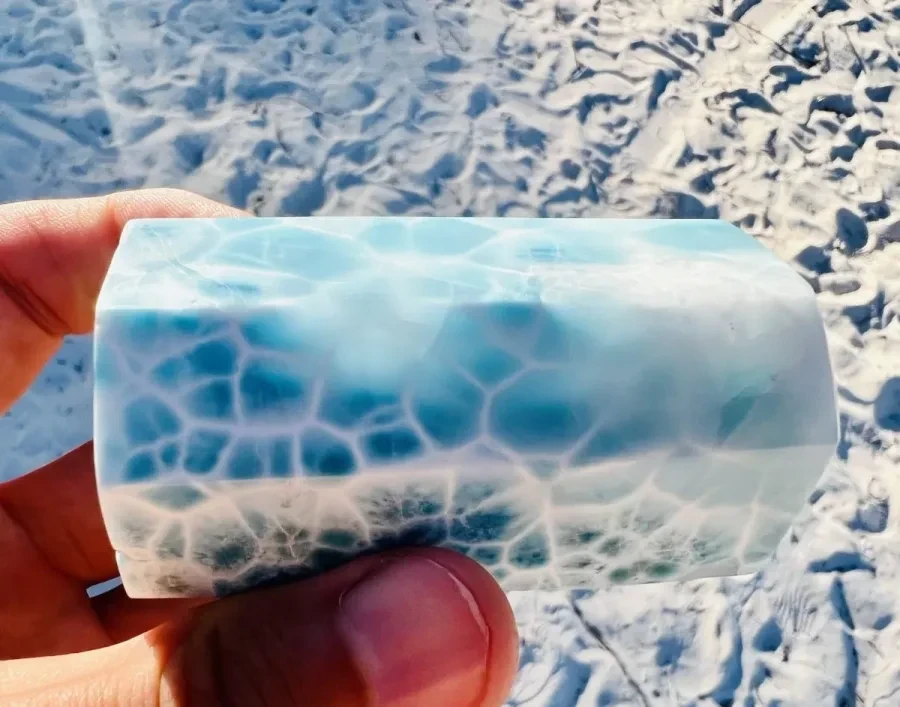
The familiar answer—“copper makes Larimar blue”—is no longer sufficient.
Copper can occur in the Larimar deposit, and native copper may appear close to or inside some specimens. That association encouraged early researchers and the trade to treat copper as the principal color-producing element. Newer analytical work, however, found that the story is more complex.
Vanadium and the blue color
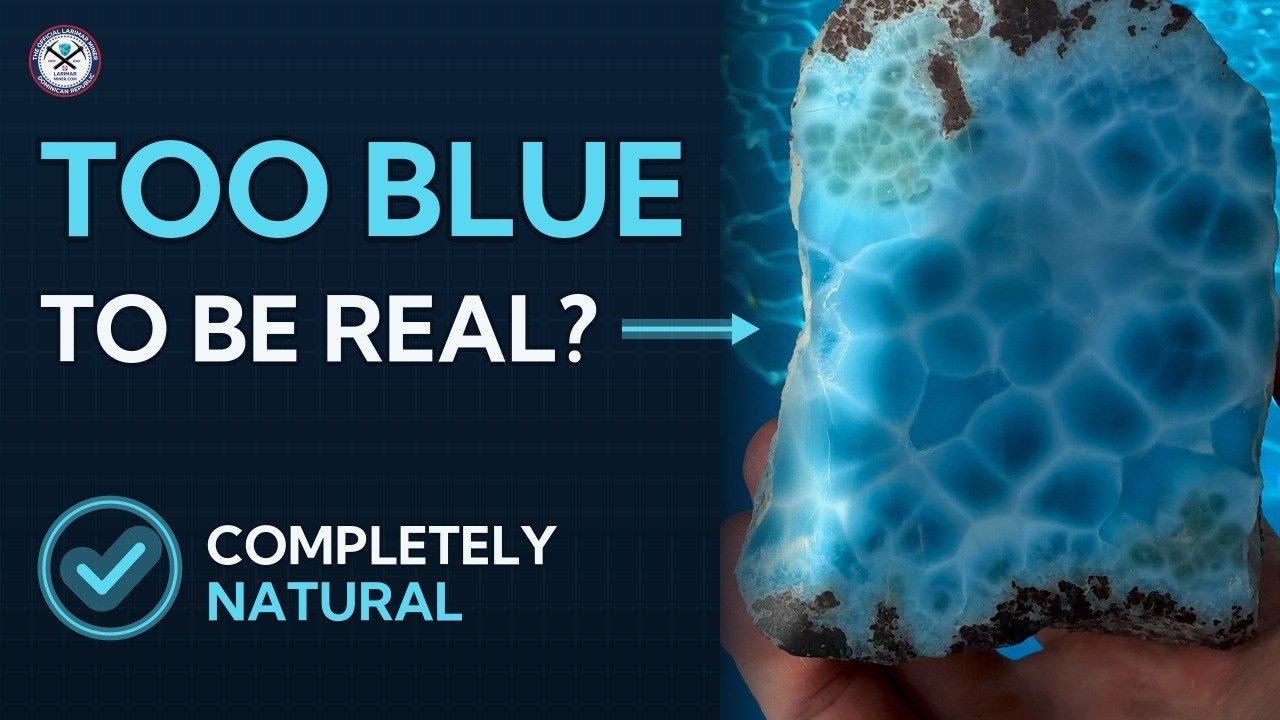
A 2023 study used laser-ablation mass spectrometry to compare trace elements in blue, green and white pectolite areas. In the tested samples, vanadium showed the strongest association with blue color. Blue areas contained substantially more vanadium on average than white or greener areas.
The authors proposed that vanadium ions substitute into calcium positions in the pectolite structure and create color centres that absorb part of the visible spectrum, leaving the material visually blue.
Iron and greener tones
The same study found higher iron concentrations in greener pectolite than in blue or white areas. The researchers interpreted iron—likely in a reduced ionic state—as an important contributor to green coloration.
Blue-green Larimar may therefore reflect a balance of multiple elements and oxidation states rather than a single pigment-like ingredient.
What about copper?
Copper was present in the host rocks and occurred as native copper or copper minerals in some associations, but the measured copper concentration inside the pectolite crystals was low in the 2023 sample set and did not correlate clearly with hue.
That does not mean copper is absent from the deposit or visually unimportant in every specimen. It means that current evidence does not support the simple universal claim that copper alone gives Larimar its blue color.
Older studies, different samples and different analytical limits produced different interpretations. Our articles retain that history because scientific correction is more useful than pretending the first answer arrived engraved on stone tablets.
Why are the white wave patterns white?
Larimar commonly develops radial bundles of fine pectolite fibres. Where differently oriented bundles meet, their crystal directions change. The 2023 study showed that these orientation changes affect how light is transmitted and reflected.
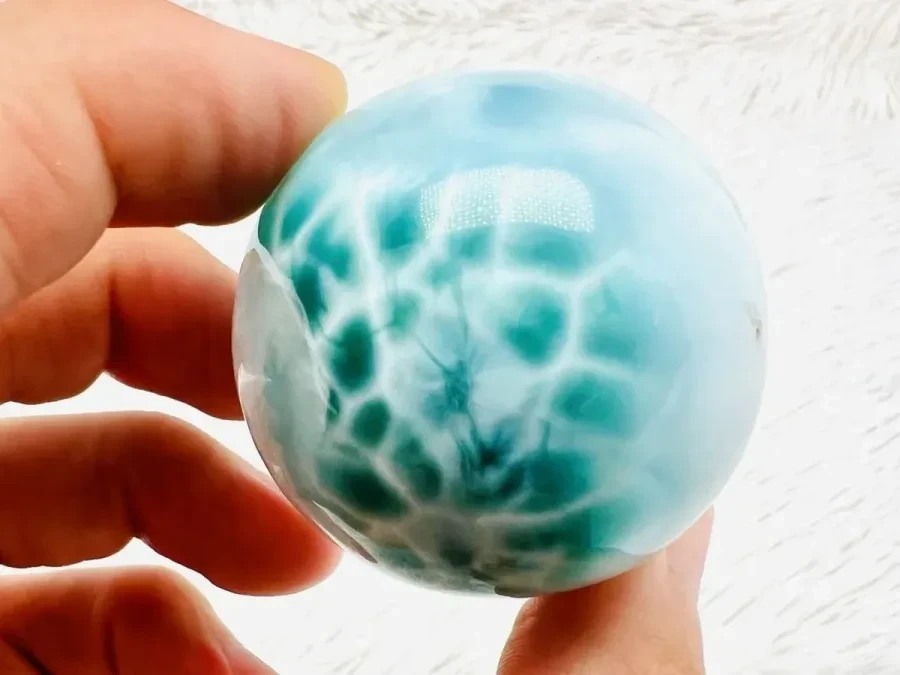
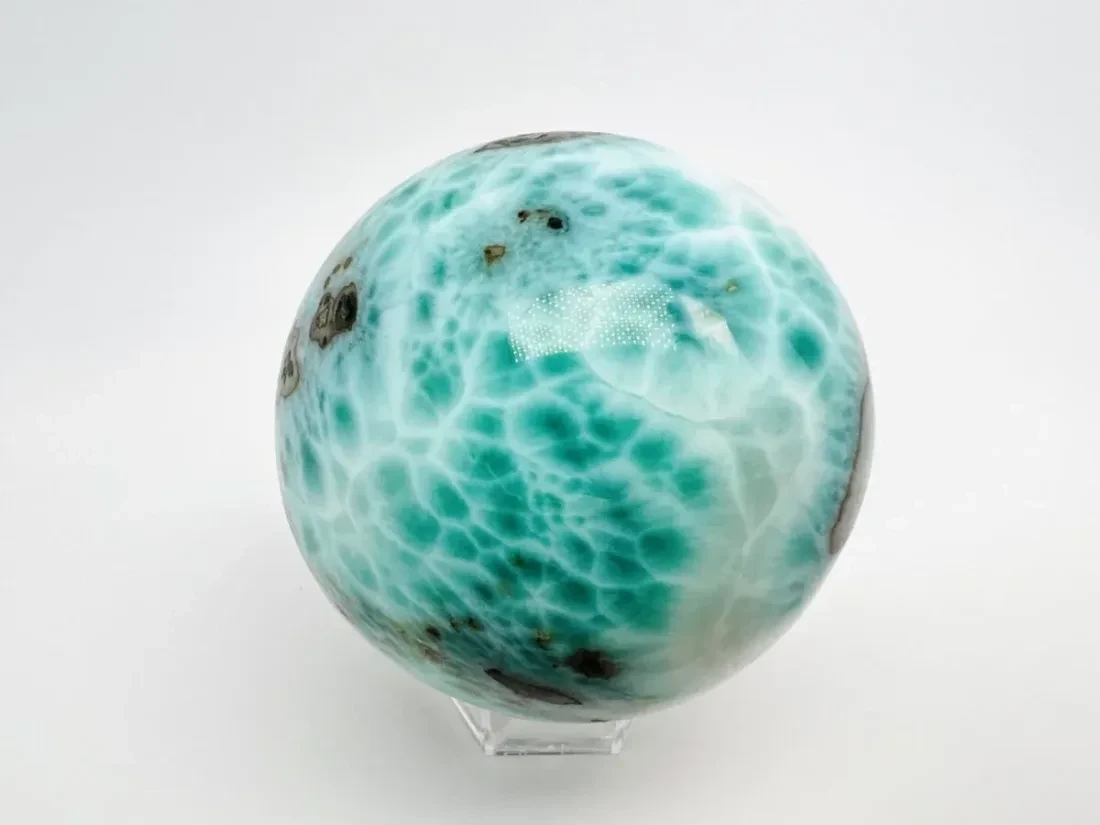
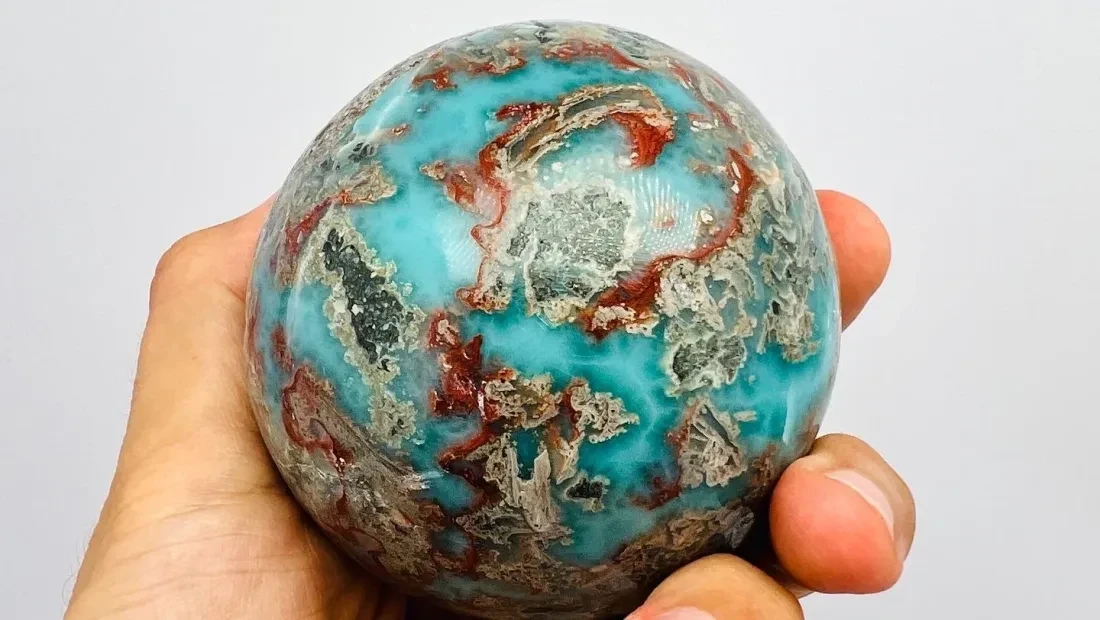
Some boundaries appear pale or white because they scatter and reflect more light. Radial centres may appear deeper blue when fibre orientation allows more light to pass through the material along a favourable direction. This optical effect helps create the famous sea-wave appearance.
The white pattern is therefore not necessarily a separate white paint-like mineral filling. In some pieces it may be mainly structural and optical; in others, associated white minerals such as calcite or natrolite may also contribute. The specimen must be examined rather than sentenced by color alone.
Heat and color stability
Laboratory heating experiments reported a progressive loss of blue at approximately 250°C, leaving duller greenish material over extended heating. That temperature is far above normal wear, but it is relevant to jewellery repair, torch work, steam cleaning and careless workshop treatment.
A classic 1989 GIA study found no obvious color change after more than 50 hours of intense fibre-optic light exposure in its test. Long-term exposure conditions vary, so sensible care remains appropriate: avoid unnecessary high heat and do not store Larimar for prolonged periods on a hot dashboard or directly against a high-intensity display lamp.
Why photographs disagree
Larimar color can look different because of:
- Daylight versus warm indoor light
- Wet versus dry surfaces
- Rough versus polished finish
- Stone thickness
- Background color
- Camera white balance
- Smartphone processing
- Screen calibration
- Reflections from sky or surroundings
Responsible sellers show more than one image, include neutral lighting and avoid pushing saturation until the Caribbean begins to glow radioactively.
Color vocabulary
Useful descriptive terms include:
- White-blue
- Pale blue
- Sky blue
- Blue-green
- Green-blue
- Saturated blue
- Deep blue
Trade names such as “volcano blue,” “electric blue” or “super blue” require a published definition if they are used as quality terms. Otherwise, they are descriptions—not independent gemological grades.
Sources and further reading
- Huang, Hao-Ming; Shih, Yu-Hong; Chen, Huei-Fen; Lee, Hao-Yang; Fang, Jiann-Neng; Shen, Chuan-Chou; Yu, Bing-Sheng. “Revealing the Secrets behind the Color and Sea-Wave Patterns of Larimar.” *Minerals*, vol. 13, no. 9, 2023, article 1221. — link
- Espí, J. A. “Estudio de fibras y colores del Larimar Dominicano / Study of fibers and colours in Dominican Larimar.” *Boletín Geológico y Minero*, vol. 128, no. 3, 2017, pp. 783–801. — link
- Woodruff, Robert E.; Fritsch, Emmanuel. “Blue Pectolite from the Dominican Republic.” *Gems & Gemology*, Winter 1989, vol. 25, no. 4, pp. 216–225. — link
- Dumańska-Słowik, Magdalena; Powolny, Tomasz; Milovský, Rastislav; Natkaniec-Nowak, Lucyna; George, Carlos; Lora, Eudalislao; Quezada, Daniel; Surmacki, Jakub. “Origin of bluish pectolite aka larimar from the Dominican Republic: Constraints from mineralogy and geochemistry.” *Journal of South American Earth Sciences*, vol. 141, 2024, article 104949. — link
Keep exploring Open all 12 lessons 0/12 visited
- Lesson 01 What is Larimar?
- Lesson 02 The history of Larimar
- Lesson 03 Larimar geology and formation
- Lesson 04 Larimar mineralogy and physical properties
- Lesson 05 Why is Larimar blue?
- Lesson 06 Larimar patterns, inclusions and associated minerals
- Lesson 07 How to care for Larimar
- Lesson 08 Larimar and the Dominican Republic
- Lesson 09 Larimar symbolism and spiritual traditions
- Lesson 10 Larimar FAQ
- Lesson 11 Larimar glossary
- Lesson 12 How to read a Larimar specimen