Peer-reviewed research
Larimar geology and formation
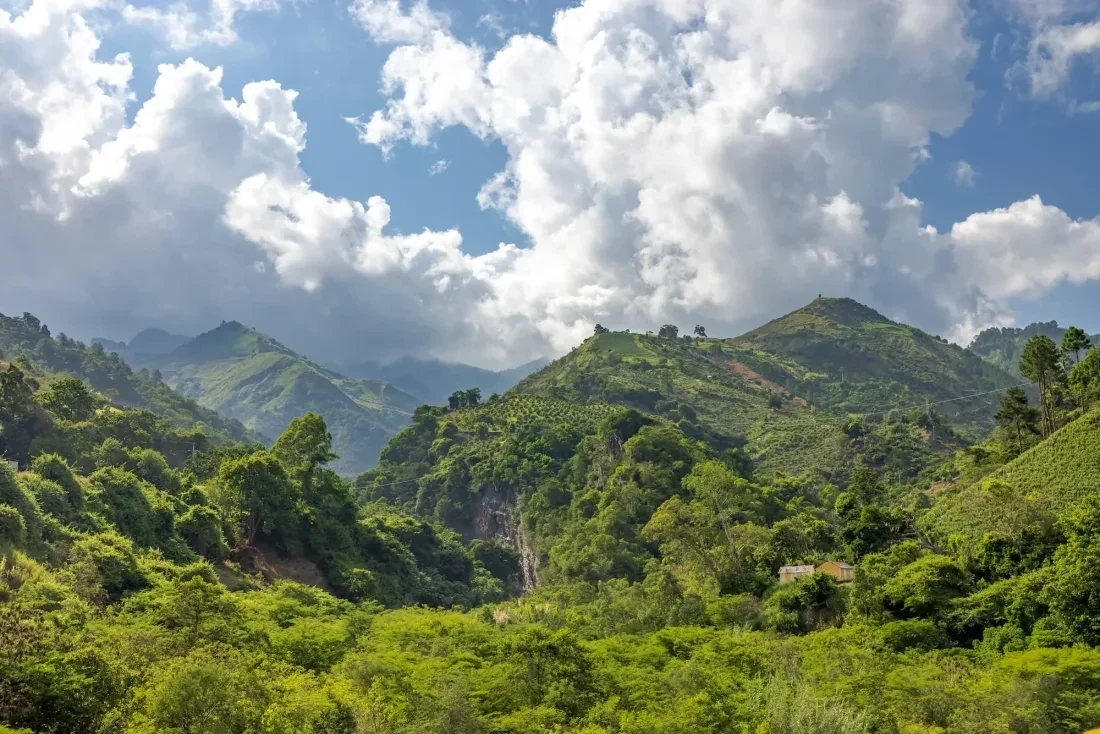
Larimar is often called a “volcanic stone.” That description points in the right direction but can create the wrong picture. Larimar is not a blue lava glass and did not emerge from a volcano already polished. Its principal mineral, pectolite, formed later inside altered volcanic rocks as mineral-bearing fluids moved through cavities and fractures.
The geological setting
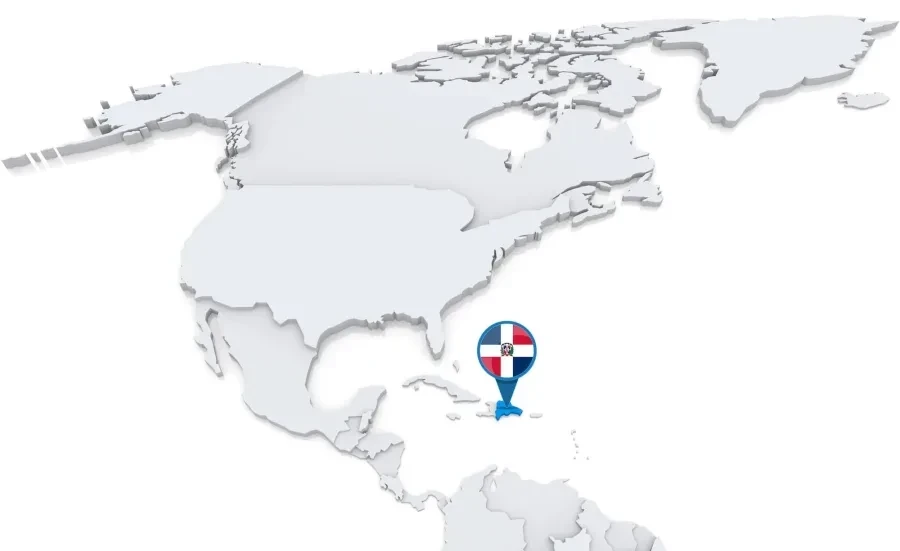
The Larimar deposit is associated with volcanic rocks in the Sierra de Bahoruco region of southwestern Dominican Republic. Scientific studies describe pectolite bodies within altered Cretaceous basalts of the Dumisseau Formation. The host rocks have experienced weathering, alteration, fracturing and fluid circulation over a long geological history.
The deposit is not a continuous blue layer waiting to be peeled from the mountain. Pectolite occurs in veins, cavities and amygdales—spaces in volcanic rock that were later filled by minerals. Bodies can narrow, widen, terminate or change composition over short distances, which is one reason exploration and extraction are uncertain.
What is an amygdale?
Gas bubbles can leave cavities in volcanic rock as lava solidifies. When minerals later fill those cavities, the filled structures are called amygdales. Larimar can also occupy fractures and vein-like spaces.
A useful distinction is:
- The cavity may have formed when the volcanic rock was created.
- The pectolite filling formed later from fluids.
Confusing those events is how a rock that is tens of millions of years old becomes casually described as a Larimar crystal of exactly the same age.
Hydrothermal formation
A 2024 mineralogical and geochemical study linked Larimar to low-temperature hydrothermal activity below approximately 170°C. The authors describe alkali-rich fluids related to the volcanic system that later mixed with meteoric water—water originating from precipitation and circulating through the ground.
As temperature, chemistry, pressure and oxidation conditions changed, minerals precipitated from the fluids. The studied Larimar bodies contained pectolite together with phases such as natrolite, prehnite, calcite and chlorite. The researchers reported sequential green, blue and white pectolite in some bodies and connected the sequence to progressive cooling and possible boiling-related conditions.
This is a better model than “copper plus lava equals blue stone,” but it remains a model built from specific samples and analytical methods. Geological systems are rude enough not to fit every specimen into one tidy paragraph.
How old is Larimar?
The volcanic host rocks and the Larimar mineralization are not the same age.
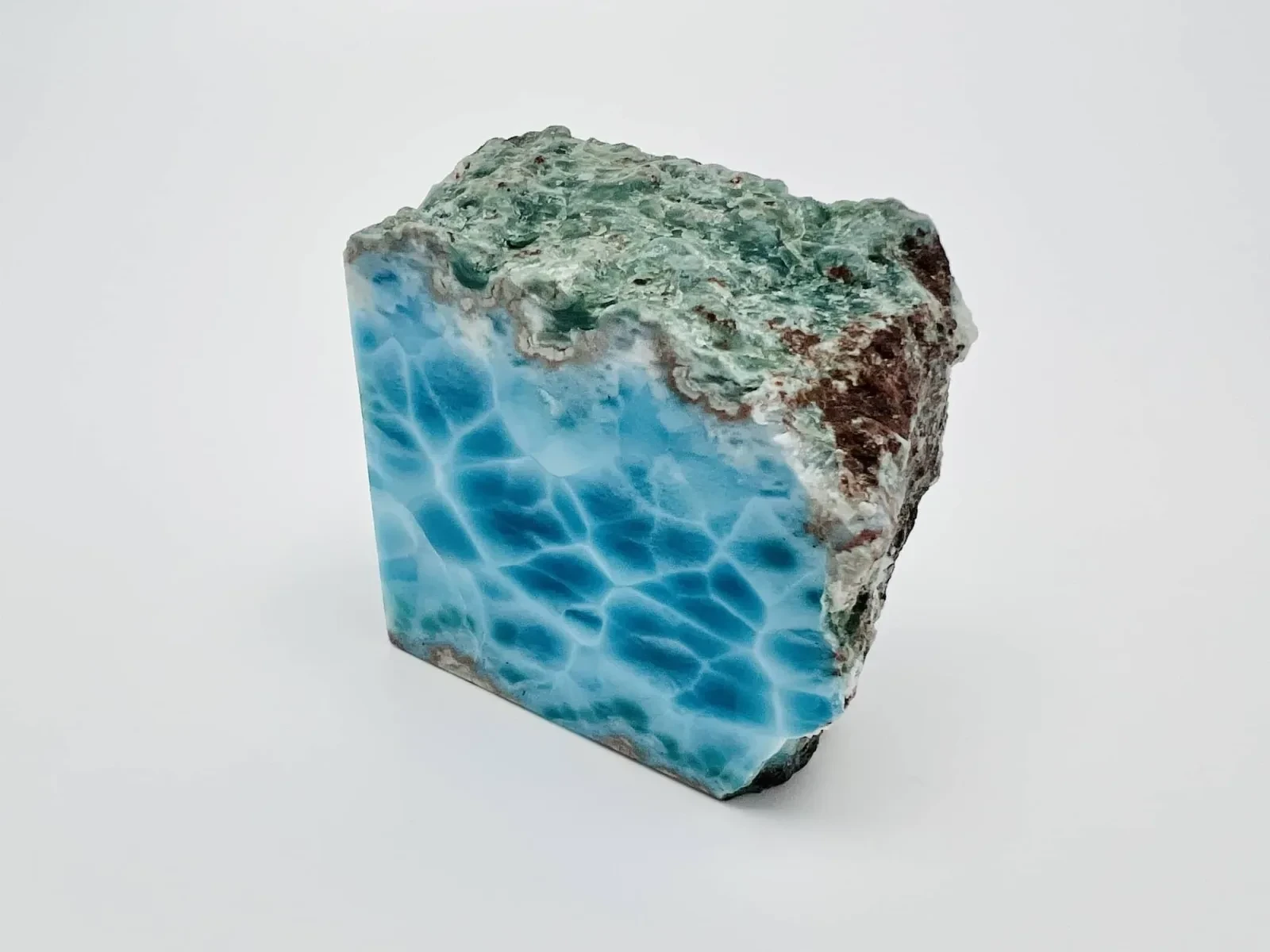
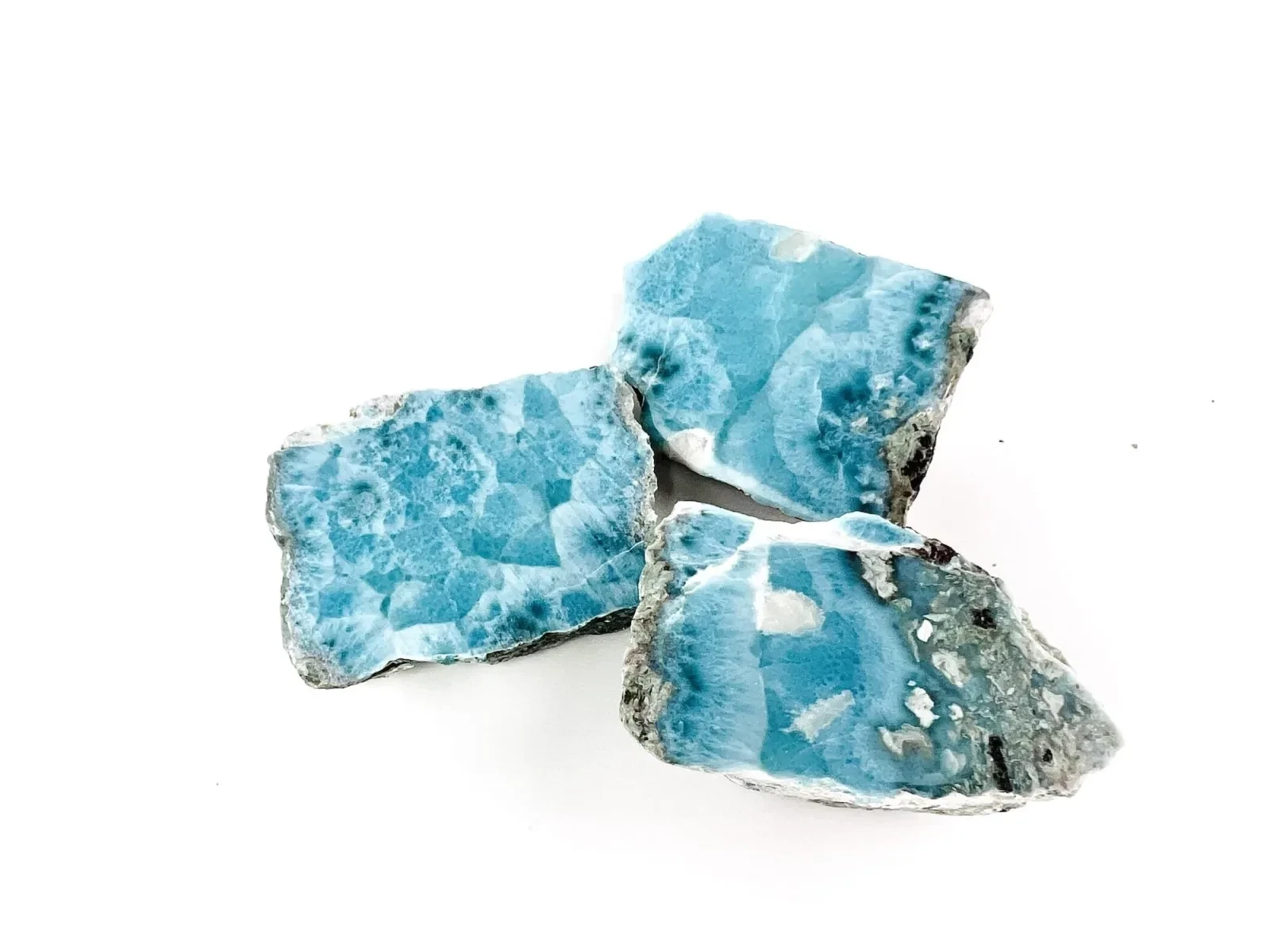
One 2023 study dated calcite associated with pectolite using uranium-thorium methods. The measured calcite age was about 393,000 years, with stated uncertainty. Because pectolite grew later in the observed sequence and because later fluids may have reset the calcite system, the authors inferred that the Larimar mineralization could be approximately 400,000 years old or younger.
That is an indirect inference from one studied association, not a universal birth certificate for every Larimar body. The scientifically responsible conclusion is that the pectolite mineralization is much younger than the Cretaceous volcanic host rocks, while its precise timing requires further study.
From the mountain to the river
Weathering and erosion released some pectolite-bearing fragments from the host rock. Streams transported and rounded pieces downstream toward the Bahoruco coast. These waterworn fragments played an important role in the modern rediscovery story because their presence could be traced back toward the inland source.
Natural tumbling may smooth a fragment, but it does not authenticate it, assign a grade or prove an exact mining location.
Why the deposit is difficult to predict
Mining follows geological structures rather than a factory blueprint. Productive zones may be separated by barren or low-quality material. Color and structural integrity can change within the same body. Host-rock alteration, fractures, water and ground stability affect both recovery and safety.
This unpredictability influences:
- Exploration time
- Excavation and support requirements
- Recovery rates
- The proportion of usable material
- The maximum size of sound pieces
- The cost and risk of extraction
What remains uncertain
Important research questions remain, including:
- The full timing and sequence of mineralizing events
- How representative existing chemical studies are across the deposit
- The exact fluid pathways at different parts of the mining district
- Why exceptional color and pattern concentrate in particular bodies
- How local structural geology controls continuity and quality
A global reference site should not hide those gaps. Open questions are not a weakness; they are the part of science that has not yet been turned into a souvenir magnet.
Sources and further reading
- Dumańska-Słowik, Magdalena; Powolny, Tomasz; Milovský, Rastislav; Natkaniec-Nowak, Lucyna; George, Carlos; Lora, Eudalislao; Quezada, Daniel; Surmacki, Jakub. “Origin of bluish pectolite aka larimar from the Dominican Republic: Constraints from mineralogy and geochemistry.” *Journal of South American Earth Sciences*, vol. 141, 2024, article 104949. — link
- Huang, Hao-Ming; Shih, Yu-Hong; Chen, Huei-Fen; Lee, Hao-Yang; Fang, Jiann-Neng; Shen, Chuan-Chou; Yu, Bing-Sheng. “Revealing the Secrets behind the Color and Sea-Wave Patterns of Larimar.” *Minerals*, vol. 13, no. 9, 2023, article 1221. — link
- Broda, Krzysztof; Natkaniec-Nowak, Lucyna; Rak, Zbigniew; Stasica, Jerzy; Heflik, Wiesław; Mościcki, Jerzy; Peña, Miguel; Muñoz, Rolando; George, Carlos. “Dominican Larimar Mining—Current State and Future Prospects.” *Minerals*, vol. 12, no. 2, 2022, article 181. — link
- Woodruff, Robert E.; Fritsch, Emmanuel. “Blue Pectolite from the Dominican Republic.” *Gems & Gemology*, Winter 1989, vol. 25, no. 4, pp. 216–225. — link
- Anthony, John W.; Bideaux, Richard A.; Bladh, Kenneth W.; Nichols, Monte C., eds. “Pectolite.” *Handbook of Mineralogy*, Mineral Data Publishing / Mineralogical Society of America, version 1.2. — link
Keep exploring Open all 12 lessons 0/12 visited
- Lesson 01 What is Larimar?
- Lesson 02 The history of Larimar
- Lesson 03 Larimar geology and formation
- Lesson 04 Larimar mineralogy and physical properties
- Lesson 05 Why is Larimar blue?
- Lesson 06 Larimar patterns, inclusions and associated minerals
- Lesson 07 How to care for Larimar
- Lesson 08 Larimar and the Dominican Republic
- Lesson 09 Larimar symbolism and spiritual traditions
- Lesson 10 Larimar FAQ
- Lesson 11 Larimar glossary
- Lesson 12 How to read a Larimar specimen