Gemological reference Laboratory method
How Larimar is authenticated
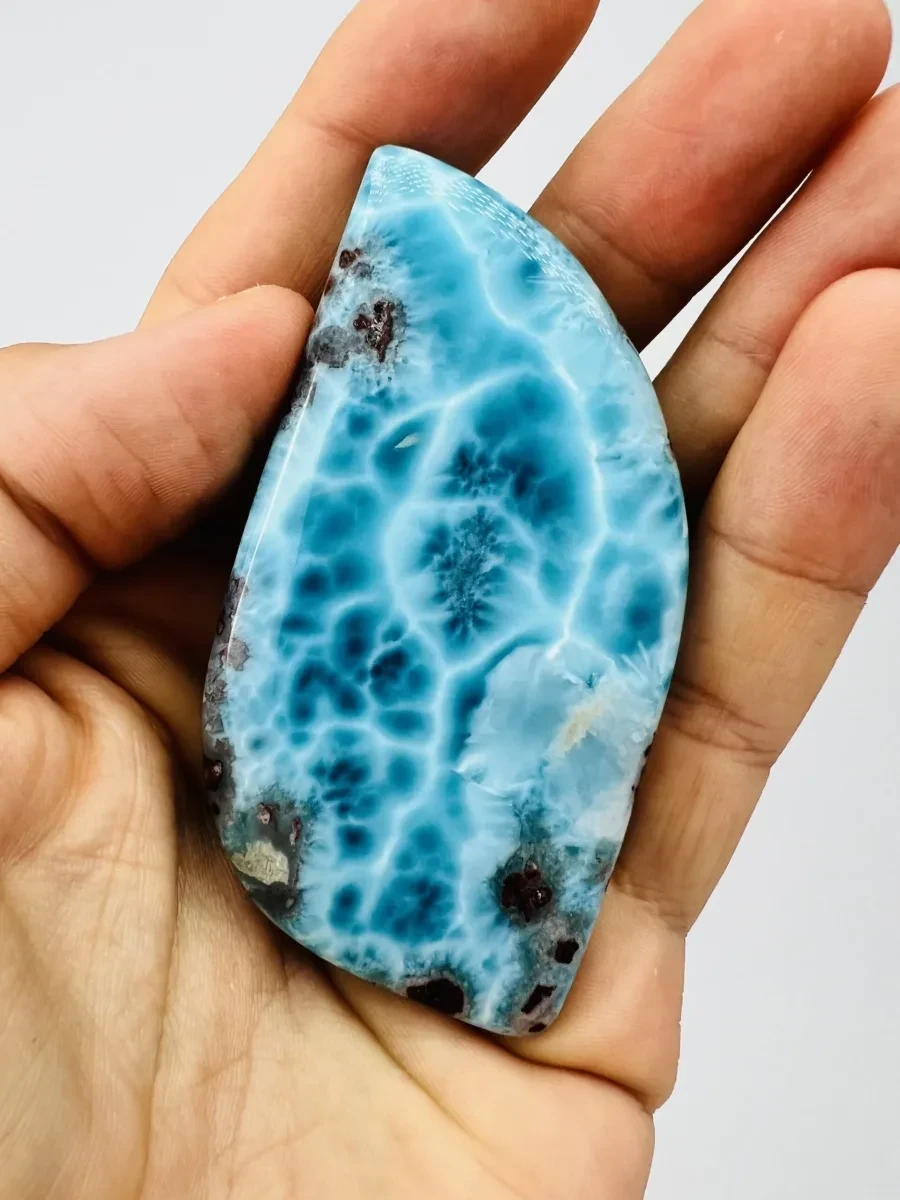
Authentication asks whether a specimen is consistent with Dominican blue pectolite and whether alternative materials can be excluded. The appropriate level of testing depends on the object, its value and the consequence of being wrong.
A modest pendant may need a documented seller, a clear invoice and sensible gemological examination. An exceptional rough specimen, disputed shipment or research sample may justify spectroscopy or diffraction. The objective is proportional evidence—not sending every bead to a synchrotron because the internet looked suspicious.
Level 1: documentation and visual examination
Record:
- Seller or supplier
- Date acquired
- Invoice number
- Stated origin
- Treatment disclosure
- Weight and dimensions
- Photographs under neutral lighting
- Visible color, pattern, matrix, fractures and workmanship
Visual examination can identify obvious moulding, repeated patterns, bubbles, surface dye concentration or materials plainly inconsistent with Larimar. It cannot conclusively prove mineral identity.
Level 2: magnification
A gemological microscope or loupe may reveal:
- Fibrous or radiating structure
- Relationships between blue and white areas
- Surface-reaching fractures
- Dye concentration
- Filling or adhesive
- Bubbles or flow features in glass or resin
- Polishing compounds trapped in cavities
Interpretation requires experience. A natural-looking feature is not necessarily diagnostic, and genuine Larimar may look different depending on orientation and finish.
Level 3: non-destructive gemological measurements
Refractive index
Pectolite has documented refractive properties, but massive fibrous aggregates may produce readings that are less straightforward than those from a transparent faceted crystal. Surface quality, orientation and associated minerals can affect the result.
Specific gravity or density
Measured density can help separate pectolite from some imitations. The result may vary with porosity, matrix, associated minerals, settings and measurement method. Mounted jewellery is generally unsuitable for a simple hydrostatic calculation.
Optical response and spectroscopy
Ultraviolet response, visible absorption and other optical observations may provide supporting information, but they should be interpreted together with stronger identifying data rather than used as a solitary pass/fail test.
Level 4: laboratory analysis
Raman spectroscopy
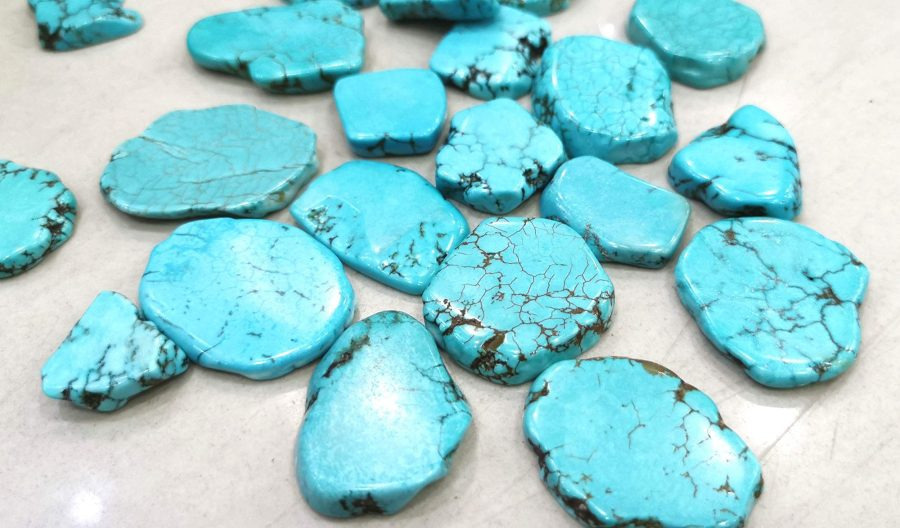
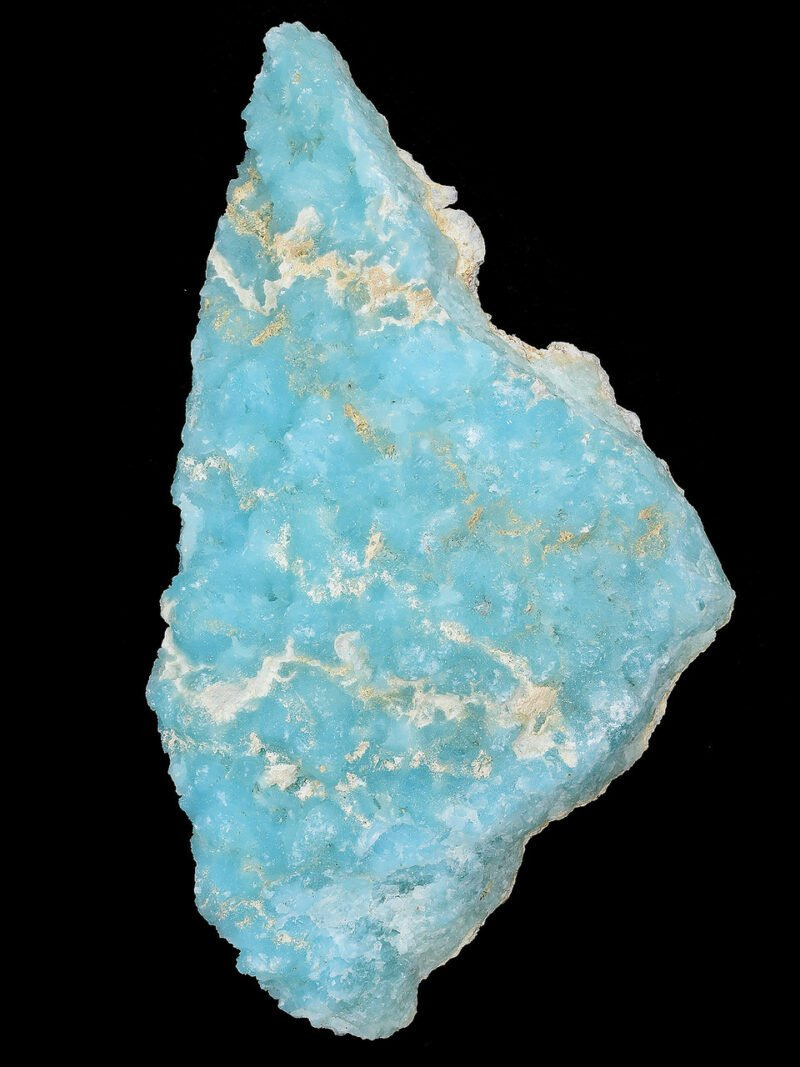
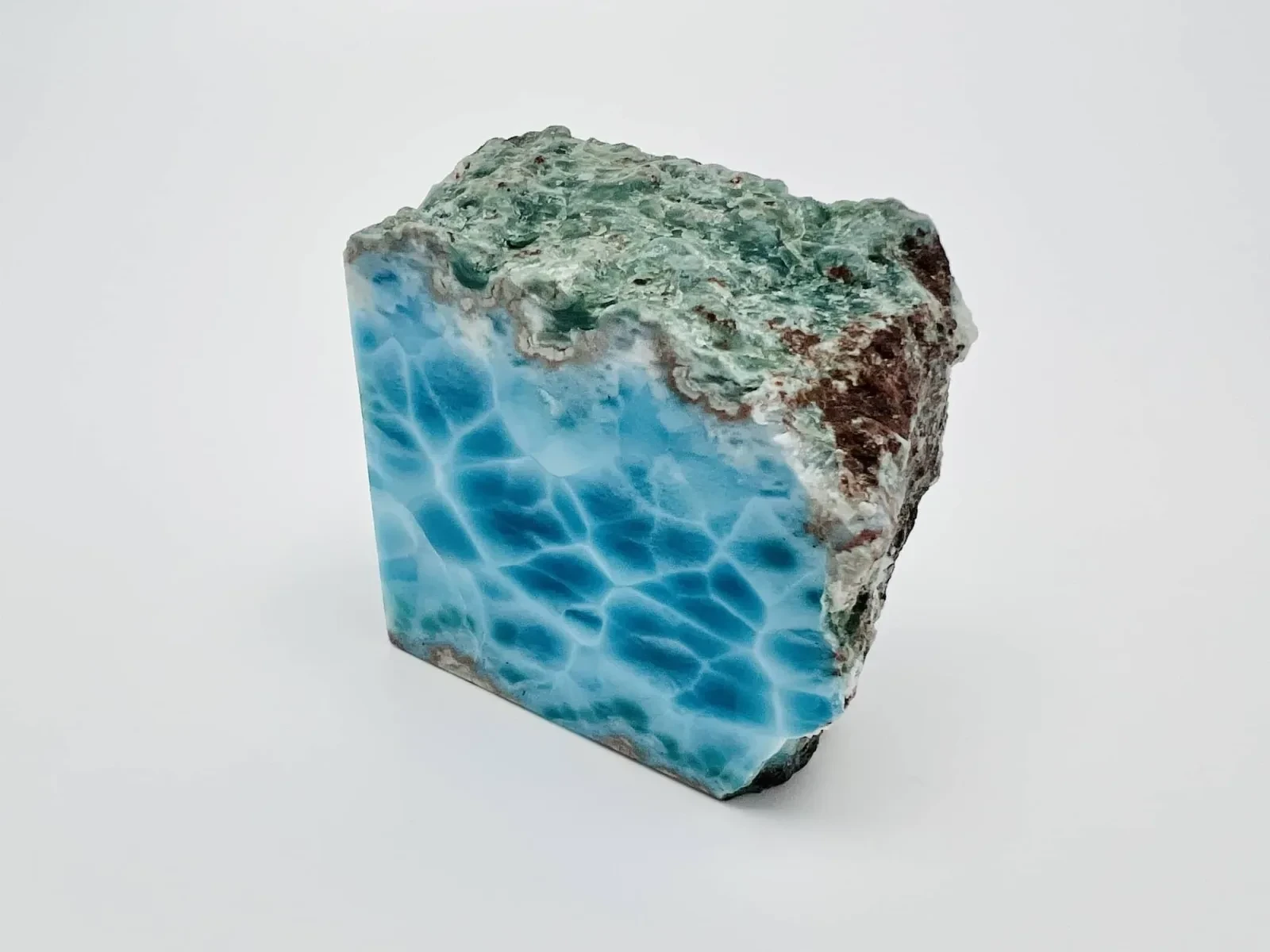
Raman spectroscopy can produce a molecular fingerprint and is particularly useful for distinguishing pectolite from materials such as chalcedony, calcite, resin or glass. It is usually non-destructive when performed appropriately.
X-ray diffraction
X-ray diffraction identifies crystalline phases and can confirm pectolite within a sample. Depending on the instrument and sample, traditional powder XRD may require removal of a very small amount of material; micro-XRD may reduce or avoid that need.
FTIR, XRF, SEM-EDS and related methods
These methods can contribute information about molecular vibrations, elemental composition and microstructure. Elemental chemistry alone may not establish a complete identification, especially in a natural aggregate containing several minerals.
Geographic origin is a separate question
Identifying pectolite does not automatically prove Dominican geographic origin. Ordinary pectolite occurs elsewhere. A conclusion of “Larimar” relies on the combination of blue gem-quality pectolite, characteristic material properties and credible Dominican provenance.
A laboratory may be able to identify the mineral without certifying the complete chain of custody. Read the exact wording of a report rather than mentally upgrading “pectolite” into “personally witnessed at a named shaft in Barahona.”
Tests consumers should avoid
Do not recommend:
- Scratching a finished piece
- Applying flame or a hot needle
- Using acids or household chemicals
- Breaking the stone to inspect the interior
- Soaking jewellery in solvents
These tests can damage genuine material, settings, fillers or adhesives and often produce ambiguous results.
What an authentication report should contain
A useful report identifies:
- Issuing laboratory or qualified examiner
- Report date and number
- Object description and measurements
- Photographs
- Methods used
- Results
- Conclusion using precise wording
- Any limitations
- Treatment observations where tested
Sources and further reading
- Woodruff, Robert E.; Fritsch, Emmanuel. “Blue Pectolite from the Dominican Republic.” *Gems & Gemology*, Winter 1989, vol. 25, no. 4, pp. 216–225. — link
- Miura, Makoto. “Quench-Crackled Dyed Blue Chalcedony Resembling Larimar.” *Gems & Gemology*, Summer 2020, Lab Notes, pp. 281–282. — link
- Anthony, John W.; Bideaux, Richard A.; Bladh, Kenneth W.; Nichols, Monte C., eds. “Pectolite.” *Handbook of Mineralogy*, Mineral Data Publishing / Mineralogical Society of America, version 1.2. — link
- Huang, Hao-Ming; Shih, Yu-Hong; Chen, Huei-Fen; Lee, Hao-Yang; Fang, Jiann-Neng; Shen, Chuan-Chou; Yu, Bing-Sheng. “Revealing the Secrets behind the Color and Sea-Wave Patterns of Larimar.” *Minerals*, vol. 13, no. 9, 2023, article 1221. — link