Documented field observation
Inside a Larimar Mine
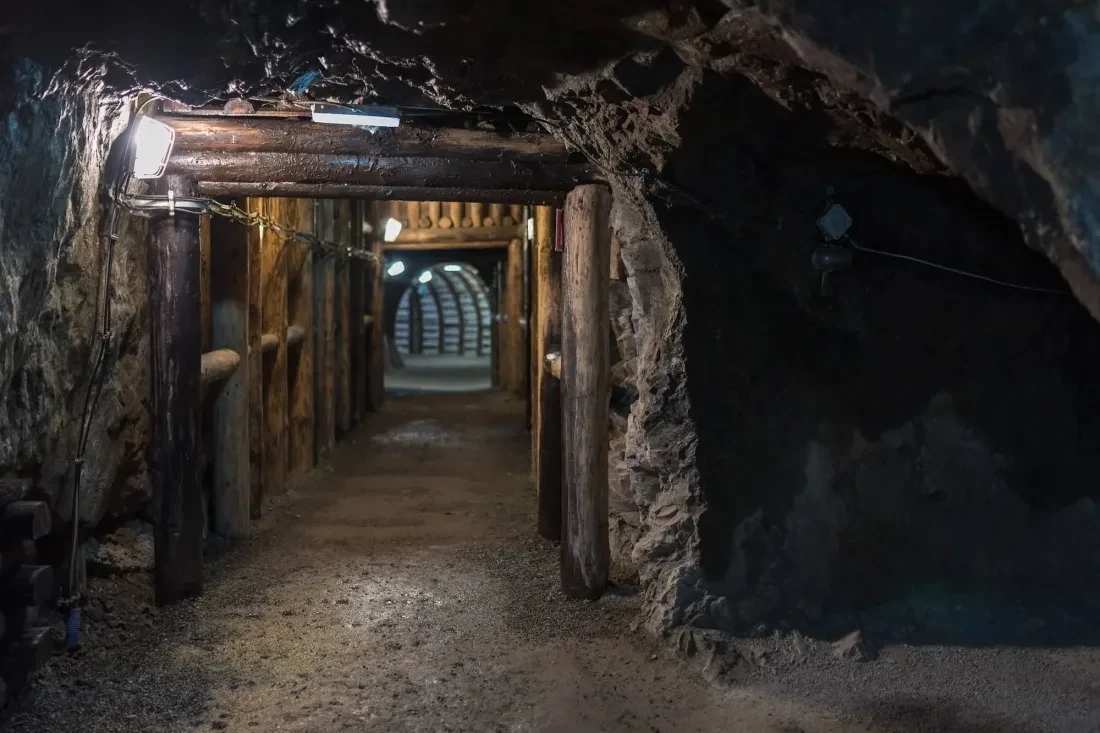
This page describes what is known about the inside of the small Larimar workings of the Los Chupaderos mining area, drawing on published accounts of the deposit and on the general picture set out in our other mining guides. It is a third-person description of typical practice, not an eyewitness report: we have not yet published a documented, dated site inspection, and until we do, nothing here should be read as a record of one specific working on one specific day.
Practices vary between workings and change over time. Where accounts differ or details are uncertain, we generalise rather than guess, and some kinds of detail — exact layouts, access points and figures that matter for safety or security — are deliberately left vague.
Before Entering
Going underground for Larimar is not a casual stroll, and entry routines in the district reflect that. Published accounts describe small crews, simple equipment and a heavy reliance on the judgment of whoever is responsible for the site. A careful entry routine is described as including steps such as these:
- Authorization from the person supervising the working before anyone goes in.
- A weather and water assessment, since recent rainfall changes both footing and air conditions in these shafts.
- A head count of everyone entering, with the same count expected back out.
- Some way of keeping contact with the surface, so that someone always knows who is below and for how long.
- Personal protective equipment such as hard hats, sturdy boots, gloves and eye protection.
- Lighting carried by each person, ideally with a spare light source.
- An agreed entry and exit route, understood by everyone before descending.
- A short emergency plan: who to call, where to gather, and how to signal a problem.
How rigorously such steps are followed varies between sites and over time, and published descriptions are often idealised. Read the list as what a well-run working aims to do, not as a guarantee of what every working does.
Access and Movement
The deposit is worked through shafts and tunnels dug into the mountainside, most of them hand-built with basic tools, as our guide to how Larimar is mined explains. Some workings are reached by sloping access tunnels, others by vertical shafts; passages are typically narrow and low, and moving through them means crouching and watching every footfall.
Reported depths in the district range from tens of metres in shallower workings to roughly three hundred metres in the deepest shafts. Individual workings differ widely, so published figures should be read as a range for the area rather than a measurement of any one tunnel.
Material broken from the face is generally carried back out along the same route, by hand and in sacks, which sets a natural limit on how much a small team can move in a shift.
Rock and Ground Support
The host rock is altered volcanic material, hard and dense in places, fractured and weathered in others, shot through with the pale veins and pockets where Larimar forms. Ground conditions can change within a few metres, and support tends to be concentrated around natural weaknesses rather than spread evenly.
Published photographs and accounts of the workings commonly show timber sets and props at the points judged to need them. That judgment is the important part. Timberwork can look reassuringly solid and still be doing very little, or look rough and be carrying real load. Ground support is an engineering function, not rustic interior design, and the decision about where it goes belongs to someone experienced enough to make it, not to a visitor admiring the woodwork.
Ventilation, Heat and Air
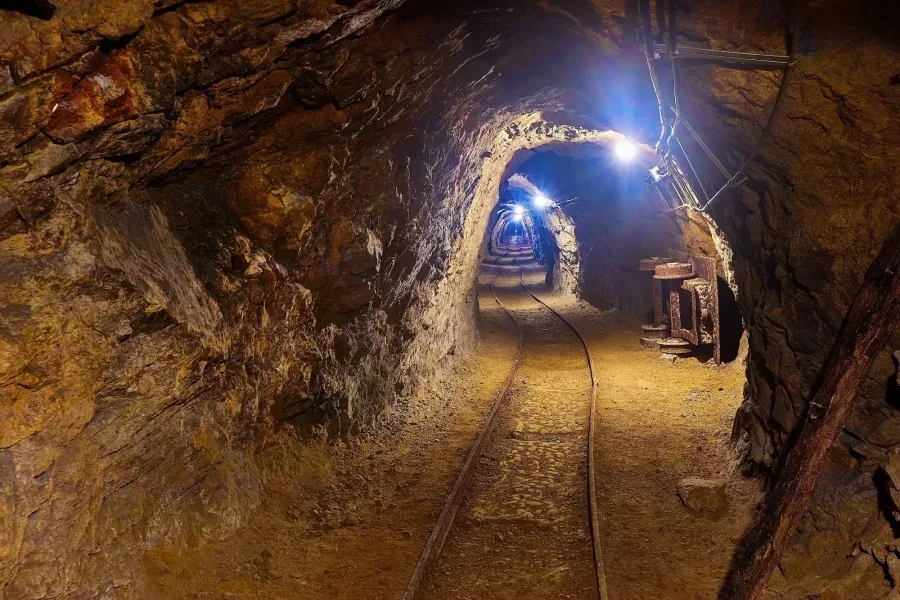
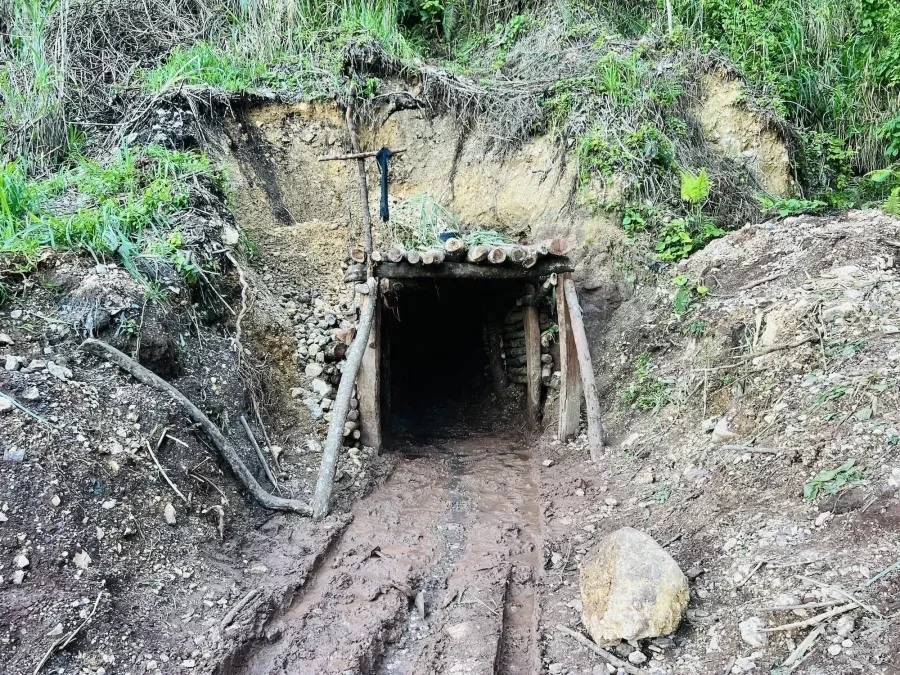
Air in small workings like these depends on depth and layout. Near an entrance, natural airflow may be enough; deeper in, accounts describe assisted ventilation — a fan and ducting pushing fresh air toward the face, with used air finding its way back along the access tunnel. The arrangement is simple but consequential: the further a working extends from its entrance, the more the air depends on that equipment working.
Conditions underground in the district are generally described as warm and humid, with the air noticeably closer near the face than at the entrance. How a particular working behaves when its ventilation equipment is down is exactly the kind of site-specific detail that only a documented inspection could answer.
Water Management
Water is a constant background concern in these workings. Accounts of the district describe drainage handled by a combination of natural runoff along tunnel floors and pumps kept on hand for wetter periods, with the exact arrangement varying from working to working.
Rainfall and groundwater clearly influence conditions: after heavy rain, parts of a working can become wet enough to pause activity. That pattern is reported consistently for the area, though the specifics differ from site to site.
Extraction and Sorting
Close to good stone, extraction is careful, manual work. Typical descriptions of the process run like this:
- Tools are straightforward: hammers, chisels and small hand-held implements used to work the softer veins free without shattering the better material. Heavy mechanical breaking is avoided close to good stone.
- Output is modest. A session at the face is described as producing on the order of a few sacks of rough material, of which only a fraction holds Larimar worth keeping.
- Material is separated into broad categories on the spot: pieces clearly worth cleaning and grading, marginal pieces set aside for a closer look, and waste rock.
- A piece is retained when its colour and pattern look promising, rejected when it is cracked or dull throughout, and set aside as a specimen when it shows an unusual structure worth examining later.
- Associated minerals in the host rock are best identified by later examination rather than guessed at in the moment — a principle we follow in our own documentation.
The People
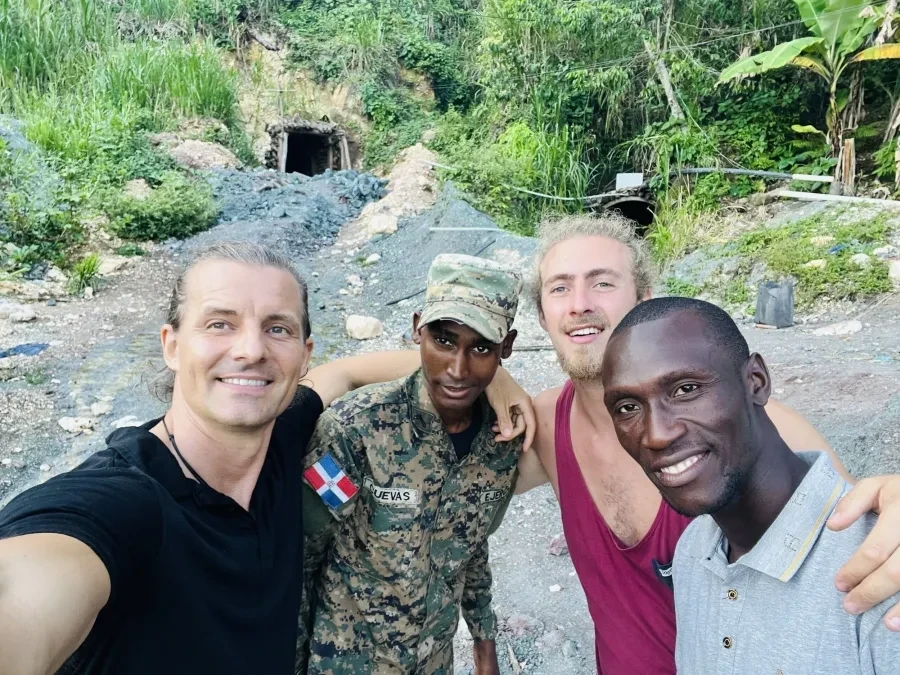
The people who do this work are the centre of the story. The workings run on small crews and divided roles: someone responsible for the site who decides who goes in and when, experienced miners who read the rock and lead at the face, and the hands who carry, sort, and clean.
Much of the skill involved is unwritten. Knowing where a vein is likely to run, how hard to strike, and when to stop and switch to careful hand work is knowledge built over years. It deserves better than an anonymous "local miner" caption, and we try to give it that respect throughout this site.
About This Account
In the interest of honesty about what this page is and is not:
- It is a third-person description of typical, publicly described practice in the Los Chupaderos workings, not the record of a specific visit.
- Figures such as depths and output are ranges reported for the district, not measurements we have taken.
- Practices vary between workings and change over time; a working you visit may do more, or less, than described here.
- Exact layouts, access points and other sensitive details are deliberately left vague.
- We intend to replace this general account with a documented, dated field record once a site inspection can be published with the operators' approval; until then, read it as background, not testimony.